- Oberhöchstadter Str. 8, 61440 Oberursel
- 06171 591 91
- Am Salzhaus 6, 60311 Frankfurt am Main
- 069 920 380 90

- Oberhöchstadter Str. 8, 61440 Oberursel
- 06171 591 91
- Am Salzhaus 6, 60311 Frankfurt am Main
- 069 920 380 90
One Thigh lift – medical Thigh Dermolipectomy – is a surgical procedure to tighten the thighs. During the procedure, excess skin and, if necessary, fat tissue are removed; the remaining skin is tightened, and the tissue is reshaped.
The result: firm, slender thighs with harmonious contours that complement your body and significantly improve your quality of life.
Here, too, the most common reason is significant weight loss after which the skin has not retracted. Depending on the extent of the issue, the incision runs in the groin or additionally down the inner thigh. If the skin is still elastic and only a pocket of fat is a concern, liposuction without a lift may be an option. This area is subject to movement and moisture, which is why wound healing requires more patience than in other parts of the body, and follow-up care is planned accordingly. Consultations take place in Frankfurt; surgeries are performed in Oberursel.
Advantages · Who is it for? · C-Section vs. T-Section · Procedure · Aftercare Timeline · Risks · Costs · Alternatives · Team · FAQ · Date
After major weight loss, excess skin on the thighs rubs together when you walk and often becomes inflamed. Plan on two to three nights in the hospital; depending on your job, you will be off work for two to six weeks, and exercise is possible again after six to eight weeks. Whether a C or T incision is needed is something we determine during the examination.

Medically reviewed ✓
Written by Dr. med. Zeynep Potente
Specialist in Plastic and Aesthetic Surgery
✓ Member of the DGPRÄC (German Society of Plastic, Reconstructive, and Aesthetic Surgeons)
EBOPRAS – European Board of Plastic, Reconstructive and Aesthetic Surgery - ebopras.eu
✓ Over 20 years of experience in plastic surgery
✓ Specialization: Body surgery and skin tightening procedures
📅 Last updated: August 11, 2026
⭐⭐⭐⭐⭐ 5.0 on Google · over 300 more reviews on Jameda
✓ Member of the DGPRÄC (German Society of Plastic, Reconstructive, and Aesthetic Surgeons)
✓ Our own certified operating rooms in Oberursel
✓ Toned, well-defined thighs – Excess skin is permanently removed
✓ Greater freedom of movement – No more chafing on the thighs when walking
✓ Long-lasting – The results last for many years as long as your weight remains stable
✓ Harmonious Silhouette – The legs complement your slender figure
✓ More Self-Confidence – Finally wearing clothes that make me happy again
✓ Treatment of Skin Problems – Inflammation caused by chafing skin goes away
✓ Can be combined – Ideal in combination with liposuction or other body contouring procedures
✓ Recognition of Your Achievements – Your weight loss is finally becoming noticeable
If you have excess skin after significant weight loss
You’ve reached your goal—an impressive achievement. But the skin on your thighs has lost its elasticity and can’t retract. What remains are sagging folds of skin that rub against each other when you walk and often cause inflammation. While exercise tones the muscles, it cannot eliminate sagging skin.
When age-related sagging affects your quality of life
As we age, the skin loses its elasticity and firmness. The inner thighs are particularly affected by this. The skin sags, forms wrinkles, and looks loose—even if you’re at a normal weight and feel fit. These changes cannot be reversed with creams or exercise.
When is a medical evaluation advisable?
For very extensive body contouring procedures, especially following significant weight loss, we recommend a preliminary internal medicine evaluation. If you have pre-existing conditions such as diabetes, lymphedema, or vascular diseases, a thorough evaluation is important. Female smokers should consistently abstain from nicotine for at least 4 weeks before and after the surgery. We work closely with experienced specialists to ensure your safety.
| Aspect | C-section (mini-tuck) | T-incision (complete tightening) |
|---|---|---|
| Main Objective | Mild to moderate sagging at the top of the thigh | Significant sagging down to the knee |
| Skin Removal | Moderate amount | Large quantity, even vertically |
| Duration of surgery | 2–2.5 hours | 3–4 hours |
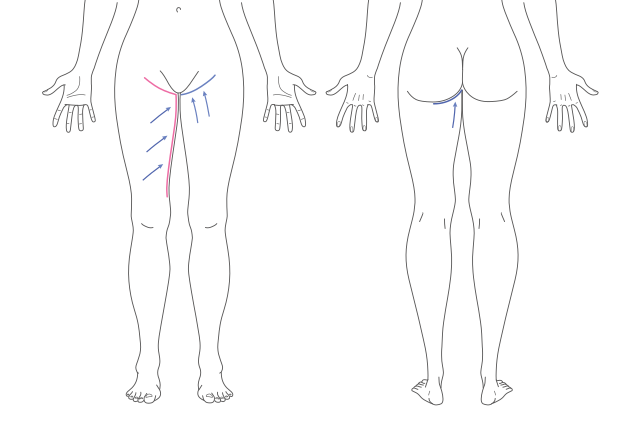
| Cutting Technique | Semicircular in the groin and gluteal folds | Crotch seam + vertical seam along the inner thigh to the knee |
| Scars | Only in the groin and buttocks (easy to hide) | Additional vertical scar on the inner side (more visible) |
| Anesthesia | General anesthesia | General anesthesia |
| Hospital Stay | 2–3 nights | 2–3 nights |
| Recovery time | 2–3 weeks | 3–4 weeks |
| firming effect | Moderate, mainly in the upper range | Maximum, entire thigh |
| Special Features | Scars can be easily concealed under swimwear | More extensive tightening, longer scars |
| Costs starting at | 5.500 € | 7.000 € |
We take the time to listen to you. During a detailed consultation, we’ll assess your thighs, discuss your goals, and create a personalized treatment plan.
What we'll discuss:
C-incision (mini thigh lift):
For mild to moderate sagging in the upper thigh area, we make a semicircular incision in the groin and pubic region that extends into the gluteal crease. The skin is pulled upward and excess tissue is removed. It is important to secure the skin to the pubic bone so that the scar does not migrate downward later on. The scars are well concealed in the natural skin folds and are not visible under swimwear.
T-incision (complete thigh lift):
In cases of significant sagging that extends down to the knee, a vertical incision is made on the inner thigh in addition to the horizontal incision in the groin. This allows for the removal of large amounts of skin and a comprehensive tightening of the entire thigh. Although the vertical scar on the inner thigh is more visible, it fades over the course of several months into an inconspicuous line.
Combination with liposuction:
If there are fat deposits in addition to sagging skin, the lift can be combined with liposuction. This further improves the contours and creates a more harmonious silhouette.
Where will the surgery take place?
In our own certified operating rooms in Oberursel (Oberhöchstadter Str. 8). From preoperative preparation through the surgery to the recovery room—everything under one roof.
Our specialist in anesthesiology, Dr. med. Livia Köhler, will personally care for you throughout the entire surgery.
The First 48 Hours: Hospital Stay and Intensive Care
After the surgery, you will stay at our clinic for 2 to 3 nights for observation. In the first few days, drains will be inserted to remove wound fluid—these will be removed after 2 to 5 days. You will receive pain medication, anticoagulant injections, and antibiotics to prevent infections. Compression stockings will be put on immediately after surgery. Keep your legs slightly elevated and avoid sitting or standing for long periods of time.
Days 3–7: Initial Mobilization
Starting on the third day, you’ll become increasingly mobile. Short walks are important to promote blood circulation and prevent blood clots. Sitting may be uncomfortable at first—use a soft seat cushion. You can shower once the drains have been removed. Continue to wear your compression pants consistently.
Week 2: Suture Removal
The stitches will be removed after 10 to 14 days (unless they are dissolvable). You will feel increasingly comfortable and can shower again. Continue to wear the compression pants day and night. Swelling and bruising will gradually subside. Light office work is possible after 2 weeks, but you should wait a while before returning to physically demanding work.
Weeks 3–6: Returning to Everyday Life
After 2 to 3 weeks, you will be largely mobile again. You should wear the compression pants for a total of 6 to 8 weeks. The swelling will gradually subside. You will be able to walk upright again and move more normally. Physically strenuous activities are possible after 4 to 6 weeks.
Sports, Sun, and Sauna: Take a 6–8-week break
Give your body at least 6 to 8 weeks off from exercise. Light walks are possible starting in week 2. You should avoid saunas and swimming pools for 6 to 8 weeks. Protect the scars from direct sunlight for 12 months by using sunscreen with an SPF of 50+ or higher.
Scar Care Starting in Week 3
Once the wounds have completely closed, intensive scar care begins. Applying special scar ointments or silicone gel daily, as well as gently massaging the scars, promotes healing. The scars are red and raised at first, but fade over 6 to 12 months into inconspicuous, light-colored lines.
The final result after 6–12 months
The full, final results of your thigh lift will be visible after 6 to 12 months—by then, healing will be complete, all swelling will have subsided, the scars will have faded, and you’ll be able to fully enjoy your firm, slender thighs.
As with any surgical procedure, there are potential risks associated with a thigh lift. We will discuss these with you in detail:
Common (temporary):
Rare:
Very rare:
Our experienced team minimizes these risks through precise surgical techniques, careful patient selection, securing the skin to the pubic bone (which prevents scar displacement), and close follow-up care. It is especially important that you consistently avoid nicotine before and after surgery.
The cost depends on the extent of the body contouring, the method chosen, and any combinations.
| Performance | Costs starting at |
|---|---|
| C-incision (mini thigh lift) | 5.500 € |
| T-incision (complete thigh lift) | 7.000 € |
| Additionally: Thigh Liposuction | approx. 2,000–3,000 € |
| Additionally: Buttock Lift | individual |
| Hospital Stay | 500 € per night, not included in the surgery price |
| General anesthesia | 1,000 €, not included in the surgery price |
| Compression Pants | approx. 100–150 € (sold separately) |
Included in the price
In addition to the price
Cash acquisition?
A thigh lift is generally considered a cosmetic procedure and is not covered by health insurance. Exceptions:
In these cases, you can apply to have the costs covered. To be eligible, your weight must have remained stable for at least 6 to 12 months. We will assist you with the application process by providing the necessary documentation and medical reports.
Alternatives to Surgery
Depending on the extent of the sagging, other treatments may also help:
However, in cases of true skin laxity following weight loss, there is no alternative to surgical tightening.
Useful Combinations
The results can often be improved with complementary treatments:
We provide honest, personalized advice—only what truly suits you and meets your needs.




You will stay at the clinic for 2–3 nights. After 2–3 weeks, most patients are able to return to work (office work); physical labor is possible after 4–6 weeks. You can resume sports after 6–8 weeks. You will see the final results after 6–12 months.
With a C-section, the scars run along the groin crease and the buttock crease—they can be easily concealed under underwear and swimwear. With a T-incision, there is an additional vertical scar on the inner thigh that is visible at first but fades significantly over 6–12 months. With proper scar care, they become increasingly less noticeable.
In most cases, no, since this is a cosmetic procedure. If there is a medical necessity (chronic inflammation, limited mobility, severe psychological distress) following significant weight loss, you may apply for coverage of the costs. A prerequisite is a stable weight over a period of 6–12 months. We will assist you with the application process.
If your weight remains stable, the results are long-lasting and can last for many years or even decades. However, significant weight gain or further weight loss can cause the skin to stretch again. A healthy, stable lifestyle is the best way to maintain the results.
Yes, both thighs are always operated on at the same time to achieve a symmetrical result. As a result, the surgery takes longer (3–4 hours), but it is more efficient than two separate procedures.
You won’t feel a thing during the surgery because you’ll be under general anesthesia. After the surgery, it’s normal to feel some tightness and moderate pain, which can be easily managed with medication. Sitting may be uncomfortable for the first few days—a donut cushion can help. Most patients describe the pain as bearable.
Ideally, your weight should have been stable for at least 6–12 months. If you’ve had bariatric surgery, you should have reached your target weight and maintained it. Do not plan to lose any more weight, as this would cause your skin to sag again.
OP duration: 2–4 hours (depending on the scope)
Type of anesthesia: General anesthesia
Hospitalization: 2–3 nights as an inpatient
Incapacity for work: 2–3 weeks (office work), 4–6 weeks (physical work)
Sport: after 6–8 weeks
Socially Acceptable: after 2–3 weeks
Scarring: In the inseam pleat (+ vertically for a T-cut)
Shelf life: Sustained at a stable weight
Final result visible: after 6–12 months
Costs: Starting at €5,500 (C-section), starting at €7,000 (T-section)
Acquisition of a pharmacy: Possible if medically indicated following weight loss
Follow-up care included: Yes, all follow-up appointments
Write to us! We will be happy to advise you!