- Oberhöchstadter Str. 8, 61440 Oberursel
- 06171 591 91
- Am Salzhaus 6, 60311 Frankfurt am Main
- 069 920 380 90

- Oberhöchstadter Str. 8, 61440 Oberursel
- 06171 591 91
- Am Salzhaus 6, 60311 Frankfurt am Main
- 069 920 380 90
The lymphatic system transports fluid, proteins, and other substances from the tissues back into the bloodstream.
If this drainage is disrupted, fluid gradually accumulates in the tissue. This results in Lymphedema.
There are essentially two forms.
In primary lymphedema, the lymphatic system is altered from birth or as a result of developmental factors.
Lymphatic vessels, for example, may be too small, present in insufficient numbers, or functionally impaired.
In secondary lymphedema, the lymphatic system was originally normal but was later damaged.
A common cause is medically necessary cancer treatment involving the removal or radiation of lymph nodes.
Other causes may include injuries, infections, or major surgical procedures.
Advantages · Who is it for? · What is Lymphedema? · LVA · Lymph Node Transfer · Liposuction · Procedure · Aftercare Timeline · Risks · Costs & Health Insurance · Alternatives · Team · FAQ · Date
Lymphedema often develops gradually.
Your leg feels heavier. Shoes, pants, or stockings suddenly feel tighter. After a long day, the swelling increases. You may need to wear compression garments daily or undergo lymphatic drainage regularly.
For other patients, it all begins after surgery or tumor treatment—sometimes immediately, sometimes only months or years later.
Chronic lymphedema is much more than a cosmetic problem. The persistent swelling can restrict mobility, cause a feeling of tightness, and significantly impair quality of life.
Conservative treatment remains an important component of therapy. At the same time, microsurgical and volume-reducing surgical procedures are now available that can offer an additional treatment option for carefully selected patients.
Our goal is not to promise a quick cure. We want to work with you to determine which treatment offers the best chance of reducing swelling, discomfort, and the need for ongoing therapy in the long term.

Medically reviewed ✓
Written by Dr. med. Zeynep Potente
Specialist in Plastic and Aesthetic Surgery
✓ Member of the DGPRÄC (German Society of Plastic, Reconstructive, and Aesthetic Surgeons)
EBOPRAS – European Board of Plastic, Reconstructive and Aesthetic Surgery - ebopras.eu
✓ Over 20 years of experience in plastic surgery
✓ Advanced training in lymphology and microsurgical lymphatic surgery
📅 Last updated: August 31, 2026
⭐⭐⭐⭐⭐ 5.0 on Google · over 300 more reviews on Jameda
✓ Member of the DGPRÄC (German Society of Plastic, Reconstructive, and Aesthetic Surgeons)
✓ Our own certified operating rooms in Oberursel
✓ Individualized Therapy – Treatment depends on the cause, stage, and function of the lymphatic system
✓ Microsurgical Procedures – The finest lymphatic vessels can be reconstructed or rerouted under a surgical microscope
✓ Reduction of swelling – Depending on the initial findings, the volume of the affected limb may decrease
✓ Less tension and heaviness – Reducing strain can make everyday movement easier
✓ Possibly fewer infections – In suitable patients, the frequency of recurrent inflammation may be reduced
✓ Addition to conservative therapy – Surgery and compression are not viewed as opposites, but rather are individually combined with one another
✓ Several operational options – Lymphovenous anastomoses, lymph node transfer, and liposuction treat different clinical presentations
✓ Specialized Diagnostics – Before surgery, an assessment is made to determine which procedure is anatomically and functionally appropriate
The foundation of Lymphedema treatment is initially conservative therapy.
These include, in particular, compression, exercise, skin care, and—depending on the individual’s condition—manual lymphatic drainage.
If significant swelling persists despite consistent treatment, or if the daily treatment burden is very high, surgical evaluation may be advisable.
Secondary lymphedema can develop, for example, as a result of:
Not every patient develops lymphedema following such procedures. However, if it does occur, a targeted examination of the remaining lymphatic system can determine whether microsurgical reconstruction options are available.
Primary lymphedema is caused by a congenital developmental disorder of the lymphatic system.
Symptoms may appear as early as childhood, but they may also not become apparent until adolescence or adulthood.
Surgical treatment is also possible in selected cases. This requires an accurate diagnosis of the existing lymphatic vessels.
A swollen leg does not automatically mean Lymphedema.
Venous disorders, heart or kidney disease, Lipedema, obesity, thrombosis, or other causes can also lead to an increase in circumference.
Before surgery, the cause of the swelling must therefore first be clearly determined.
Common symptoms may include:
In the early stages, the increase in volume consists mainly of fluid.
In cases of long-standing Lymphedema, the skin and subcutaneous tissue undergo progressive changes. Adipose tissue and connective tissue indurations may develop.
It is precisely these differences that are decisive in choosing the appropriate surgical procedure.
Conservative treatment remains the foundation of lymphedema therapy.
It may include, among other things:
The necessary components depend on your individual diagnosis.
Surgery does not automatically replace every conservative treatment.
However, it may be appropriate if conservative treatment options have been exhausted and specialized diagnostic testing reveals a suitable indication.
We distinguish between three key operational approaches:
The appropriate procedure depends on whether any functional lymphatic vessels remain and the extent to which the tissue has already changed.
Lymphovenous anastomosis is a supermicrosurgical procedure.
In this procedure, we connect the smallest functional lymphatic vessels to very small veins.
The idea behind this is that the lymph fluid gains a new drainage pathway and can partially bypass the damaged or interrupted lymphatic system.
Before or during treatment, the superficial lymphatic vessels can be visualized, for example, using indocyanine green and a special infrared camera.
This allows for the precise localization of suitable lymphatic vessels.
Some of the lymphatic vessels treated are less than one millimeter in size.
The connections are therefore established under a high-resolution surgical microscope.
This method is particularly useful when there are still sufficient functional lymphatic vessels present.
Accurate preoperative diagnosis is therefore crucial.
In a vascularized lymph node transfer, a small tissue graft containing lymph nodes and its own blood supply is transferred to another region of the body.
The transplanted tissue is harvested along with its artery and vein.
At the recipient site, these vessels are connected to local blood vessels under a surgical microscope.
The goal is to improve lymphatic function in the affected area and to promote the formation or interconnection of lymphatic structures.
A lymph node transfer is particularly indicated when the original lymphatic system is significantly damaged and a lymphovenous anastomosis alone does not appear to be sufficient.
We make this decision after a thorough evaluation and weighing of the benefits and risks.
In cases of long-standing Lymphedema, the increase in volume often no longer consists exclusively of fluid.
This chronic condition can also lead to an increase in fat and connective tissue.
This tissue cannot be completely removed either through lymphatic drainage or through LVA.
In such cases, specially tailored liposuction can be used to achieve a significant reduction in volume.
Unlike purely cosmetic liposuction, liposuction does not address the underlying cause of impaired lymphatic drainage.
Consistent compression therefore often remains an important part of therapy following such treatment.
| Initial Situation | Possible Treatment Approach |
|---|---|
| Functioning lymphatic vessels present | Lymphovenous Anastomosis (LVA) |
| Severe damage to the lymphatic system | Lymph Node Transfer |
| Chronic excess fat and connective tissue | Liposuction |
| Combination of Different Changes | Combination or step-by-step approach |
This table is for reference purposes only.
Which procedure is actually appropriate can only be determined after an examination and specialized diagnostic testing.
At the beginning, we’ll take the time to review your medical history.
Among other things, the following are important:
We are investigating:
If microsurgical treatment is planned, imaging of the lymphatic pathways is also recommended.
Based on these findings, we will make a decision together with you:
The lymph vessels identified earlier are located through several small incisions in the skin.
Under the surgical microscope, we connect suitable lymph vessels to adjacent small veins.
Since the vessels being treated are extremely fine, this procedure is classified as supermicrosurgery.
A small tissue sample containing a lymph node, an artery, and a vein is harvested from a suitable donor site.
At the recipient site, this tissue is connected to the local vascular system using microsurgery.
In cases of excessive fat and connective tissue accumulation, the excess tissue is reduced using a specially adapted liposuction technique.
The type of anesthesia and the length of the hospital stay depend on the chosen procedure.
Depending on the findings, a minor lymphovenous anastomosis can be performed with relatively little surgical effort.
Microsurgical lymph node transfer and more extensive liposuction procedures are generally performed under general anesthesia and require appropriate postoperative monitoring.
Our specialist in anesthesiology will personally care for you during the surgery.
Since LVA, lymph node transfer, and liposuction differ significantly, you will receive an individualized post-operative care plan for each procedure.
The First Few Days
After the procedure, we will check:
Early, cautious mobilization is generally recommended.
Week 1–2
Swelling in the surgical area is normal.
The wounds are checked regularly. Depending on the procedure, stitches may be removed or dressings changed.
We will determine on a case-by-case basis how to handle your existing compression.
Weeks 3–6
You gradually increase your daily activities.
In microsurgical procedures, the lymphatic system needs time to recover. Therefore, the outcome of a surgery cannot be reliably assessed after just a few days.
The following months
Improvements may take several months to develop.
We assess not only the circumference of the limb, but also, among other things:
As with any surgical procedure, there are general and procedure-specific risks.
General Risks
Potential Risks of an LVA
Potential Risks of a Lymph Node Transfer
The selection of the donor region and careful surgical technique are therefore particularly important.
Potential Risks of Liposuction
It is not possible to provide a flat rate for the costs of lymphatic surgery.
They depend in particular on:
After the examination, you will receive a personalized treatment plan.
Lymphedema is a medical condition.
Whether your statutory or private health insurance covers surgical treatment, however, depends on the specific procedure, the medical indication, and your insurance coverage.
Therefore, we cannot guarantee blanket coverage of costs.
We will provide you with the medical records necessary for an examination and explain which course of action makes sense in your case.
Compression is one of the most important components of lymphedema therapy.
It increases tissue pressure, supports fluid transport, and helps stabilize the treatment outcome achieved.
Depending on the findings, manual lymphatic drainage may be part of a comprehensive physical decongestive therapy regimen.
It is combined with other measures and is not considered a standalone treatment.
Muscle activity supports lymphatic drainage.
Regular exercise while wearing compression garments can therefore be an important part of treatment.
Careful skin care is especially important for people with Lymphedema.
Minor injuries and inflammation should be taken seriously, as they can increase the risk of infection in the affected limb.




Lipedema is a painful, symmetrical disorder of fat distribution in the extremities.
Lymphedema, on the other hand, is caused by impaired drainage of lymph fluid.
Lymphedema is often asymmetrical and can also affect the foot or hand.
Both conditions can also occur together.
That depends heavily on the cause and the findings.
In cases of chronic Lymphedema, a complete cure should not be promised across the board.
However, modern conservative and surgical treatments can significantly reduce swelling, discomfort, the incidence of infection, and the burden of treatment in suitable patients.
This cannot be reliably predicted for every patient prior to surgery.
For some patients, the required level of compression can be reduced following successful microsurgical treatment.
After volume-reducing liposuction, however, consistent compression is often particularly important.
In an LVA, we connect a small lymphatic vessel directly to a small vein.
This allows lymph fluid to drain into the venous system and bypass a damaged section of the lymphatic system.
Some of the vessels are less than one millimeter in size.
For this reason, the procedure is performed under a special surgical microscope and is classified as supermicrosurgery.
In this procedure, lymphatic tissue with its own blood supply is transferred from a suitable area of the body to the region affected by Lymphedema.
The arteries and veins of the graft are connected using microsurgery.
In cases of long-standing Lymphedema, fat and connective tissue—in addition to fluid—may increasingly be responsible for the large volume.
If this tissue can no longer be sufficiently reduced through decongestive therapy, liposuction may be appropriate.
There is no single surgical procedure that is suitable for every case of Lymphedema.
Key factors include:
Treatment must therefore be planned on an individual basis.
Lymphatic surgery requires patience.
Swelling immediately after surgery does not indicate the final outcome. Changes in lymphatic drainage and tissue may develop over several months.
Even after a successful operation, the underlying damage to the lymphatic system remains a concern.
Long-term follow-up care, exercise, skin care, and, if necessary, compression therapy therefore remain important.
This must be checked on a case-by-case basis.
Coverage depends on the procedure, the medical indication, previous treatment, and the respective insurance provider.
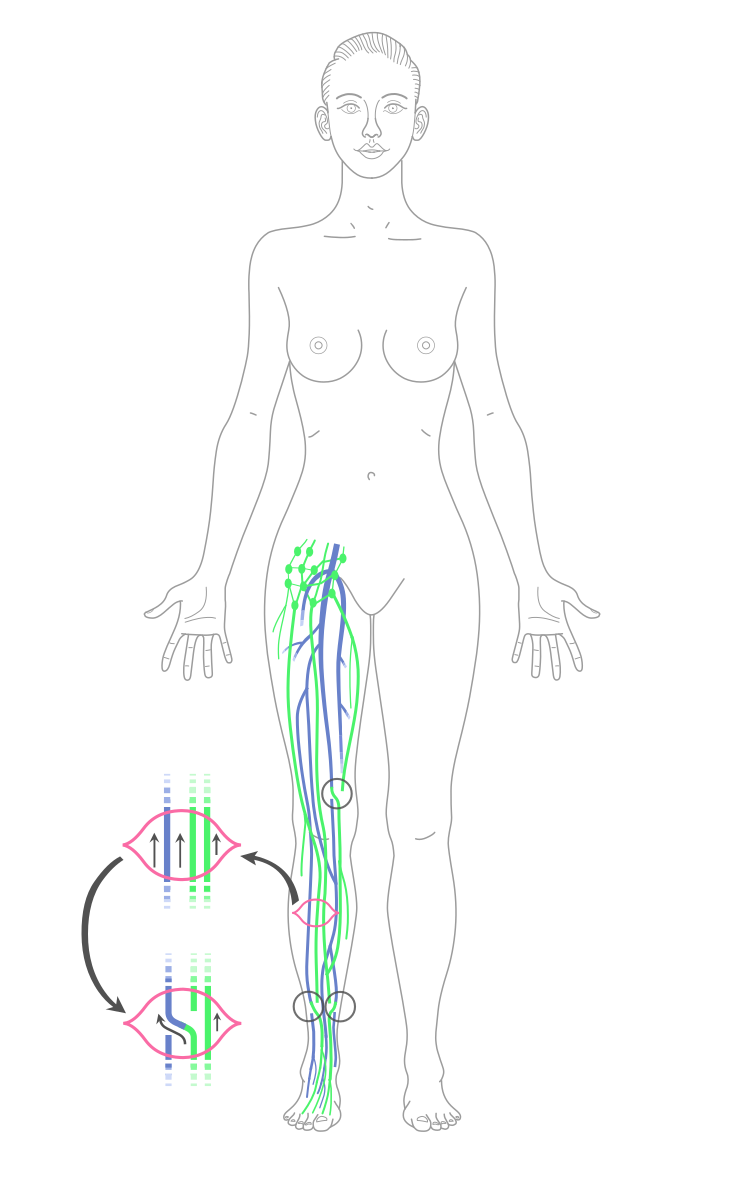
Condition: Primary or Secondary Lymphedema
Treatment Goal: Improvement of lymphatic drainage or reduction of disease-related tissue volume
Surgical Procedures: Lymphovenous anastomosis, microsurgical lymph node transfer, or liposuction
Diagnostics: Clinical examination and, if necessary, specialized imaging of the lymphatic vessels
Anesthesia: Depending on the procedure
Hospitalization: Outpatient or inpatient, depending on the procedure
Incapacity for work: Depending on the surgical procedure and professional activity
Compression: On a case-by-case basis; still required under certain procedures
Result: Progresses over a period of weeks to months, depending on the procedure
Aftercare: Regular medical checkups and individually tailored conservative treatment
Acquisition of a pharmacy: Must be reviewed on a case-by-case basis
Write to us! We will be happy to advise you!