- Oberhöchstadter Str. 8, 61440 Oberursel
- 06171 591 91
- Am Salzhaus 6, 60311 Frankfurt am Main
- 069 920 380 90

- Oberhöchstadter Str. 8, 61440 Oberursel
- 06171 591 91
- Am Salzhaus 6, 60311 Frankfurt am Main
- 069 920 380 90
Lipedema is a chronic condition of the subcutaneous fatty tissue that affects almost exclusively women.
Characteristic features include disproportionate and symmetrical accumulation of fat tissue in the extremities, as well as physical symptoms such as:
Typically, both legs are affected in a similar manner. The condition can also occur in the Arms.
It is important to distinguish this condition from a purely cosmetic fat distribution disorder: A disproportionate distribution of fat without corresponding symptoms is not medically classified as Lipedema.
Lipedema is not caused by being overweight.
At the same time, Lipedema and obesity can occur together. In this case, it makes sense to consider and treat both conditions separately.
Liposuction for Lipedema is expressly No weight-loss method. It is used to reduce the pathologically increased fatty tissue in the affected extremities.
| Aspect | Lipedema | Lymphedema |
|---|---|---|
| Cause | Excessive subcutaneous adipose tissue; cause unknown | Impaired lymphatic drainage, congenital or acquired, often following tumor or lymph node surgery |
| Distribution | always symmetrical—both legs or both arms | usually on one side, on the affected side |
| Hands and Feet | not affected | affected, often first |
| Complaints | Pain on pressure and to the touch, sensation of heaviness | Tightness and heaviness, rarely pain |
| Dimple and Skin Fold | A finger press usually leaves no indentation; the skin fold over the toes can be lifted | At first, pressing with a finger leaves a dent; later, the skin fold over the toes can no longer be lifted |
| Treatment | Compression Therapy for Pain, Liposuction | Decongestive therapy, microsurgical procedures, supplemented by Liposuction |
Both conditions can coexist. We treat both and will determine during your examination which one you have. Learn more at our page on Lymphedema treatment.
Advantages · Who is it for? · What is Lipedema? · Treatment · Liposuction · Procedure · Aftercare Timeline · Risks · Costs & Health Insurance · Alternatives · Team · FAQ · Date
Perhaps you’re familiar with this feeling: Your legs feel heavy, are sensitive to touch or pressure, and hurt—even though you stay active, watch what you eat, and have already tried many things. At the same time, your legs and midsection seem increasingly out of proportion to one another.
By this point, many patients have already come a long way. Often, the symptoms are initially attributed to being overweight, water retention, or a lack of exercise. However, Lipedema is a distinct chronic condition of the adipose tissue.
That’s why we don’t focus on a specific clothing size, but rather on your symptoms and your quality of life.
Liposuction for Lipedema can specifically reduce pathologically increased fat tissue, thereby significantly alleviating pain, tenderness, a feeling of heaviness, and restricted mobility.
Our goal is not to make you conform to some ideal of beauty. We want to help you move more freely again, experience fewer discomforts, and feel more comfortable in your own body.

Medically reviewed ✓
Written by Dr. med. Zeynep Potente
Specialist in Plastic and Aesthetic Surgery
✓ Member of the DGPRÄC (German Society of Plastic, Reconstructive, and Aesthetic Surgeons)
EBOPRAS – European Board of Plastic, Reconstructive and Aesthetic Surgery - ebopras.eu
✓ Over 20 years of experience in plastic surgery
✓ Experience in lipedema surgery and lymphology
📅 Last updated: August 31, 2026
⭐⭐⭐⭐⭐ 5.0 on Google · over 300 more reviews on Jameda
✓ Member of the DGPRÄC (German Society of Plastic, Reconstructive, and Aesthetic Surgeons)
✓ Our own certified operating rooms in Oberursel
✓ Less Pain – Pressure, touch, and spontaneous pain can be significantly reduced
✓ Less feeling of heaviness – Many patients feel that their legs are lighter and more flexible after treatment
✓ Greater freedom of movement – Reducing volume can make movement, exercise, and everyday activities easier
✓ More Harmonious Proportions – The pathologically excessive fatty tissue on the legs and, if applicable, the Arms is specifically reduced
✓ Long-term improvement – The removed fat cells do not simply regenerate; nevertheless, Lipedema itself is considered a chronic condition
✓ Technique that Preserves Lymphatic Vessels – Liposuction is specifically tailored to the needs of Lipedema
✓ Personalized Treatment – Depending on the severity, multiple body regions and multiple surgical sessions may be required
✓ Improving Quality of Life – The actual goal of treatment is a lasting reduction in symptoms
Typical symptoms of Lipedema include pain upon touch or pressure, spontaneous pain, and a pronounced feeling of tightness or heaviness in the affected limbs.
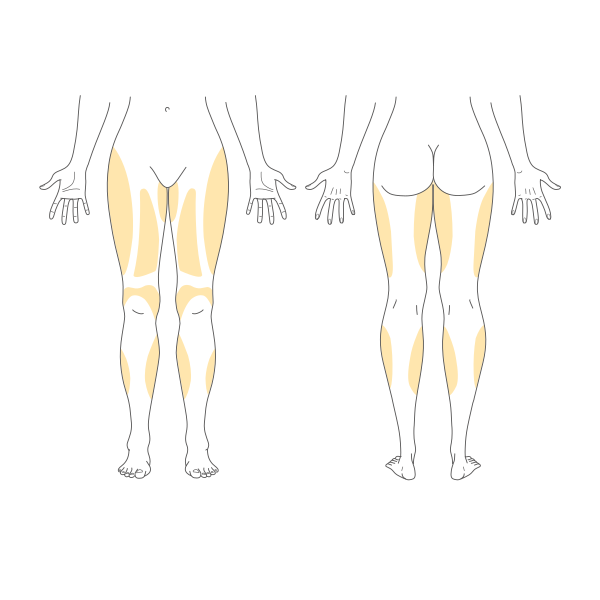
Fat distribution is typically symmetrical. The hips, thighs, knees, and lower legs are particularly commonly affected. The arms may also be affected. In classic Lipedema, the hands and feet are generally spared.
Compression, exercise, physical therapy, and other conservative measures can reduce symptoms and remain important components of an individualized treatment plan.
If symptoms persist significantly despite consistent conservative treatment, surgical fat reduction may be advisable.
In cases of more severe Lipedema, large volumes of fatty tissue can impair mobility. Skin-on-skin friction, discomfort when walking, or changes in leg alignment may also occur.
Liposuction can not only change the body’s contours here but, more importantly, provide functional relief.
Not every increase in leg circumference is Lipedema.
Similar changes can result, for example, from obesity, Lymphedema, venous disorders, or other abnormalities in fat distribution. Therefore, a thorough diagnostic evaluation is performed prior to any surgical treatment.
Comorbidities, current weight, medications, vascular diseases, and possible additional Edemas must also be taken into account.
Treatment is tailored to your individual symptoms.
Conservative options include, among others:
These measures can alleviate the symptoms but do not remove the pathologically proliferated adipose tissue.
In cases of severe and persistent symptoms, surgical removal of the affected adipose tissue may be advisable.
The goal here is not to remove as much fat as possible. What matters is a controlled, even reduction that is as gentle on the lymphatic vessels as possible.
Before the procedure, the areas to be treated are carefully examined and marked while the patient is standing.
Next, a special solution is injected into the subcutaneous fat tissue. The excess fat tissue is then carefully suctioned out through small incisions in the skin.
When treating Lipedema, it is important to use a technique that is particularly gentle on the tissue and lymphatic vessels. Vibration-assisted or water-jet-assisted procedures, for example, are suitable for this purpose.
The cannulas are guided as parallel as possible to the course of the lymphatic vessels.
Lipedema often affects large areas of both legs. These areas do not necessarily need to be treated completely in a single surgery.
Depending on the specific case, we therefore divide the treatment into several Procedures.
Possible regions include, for example:
The appropriate number of sessions can only be reliably determined after a personal examination.
The process begins with a thorough examination.
We’d like to know:
We will then discuss together whether Liposuction is a good option for you and which areas should be treated and in what order.
On the day of surgery, the areas to be treated are marked again.
After injecting the tumescent solution, the fatty tissue is evenly reduced using fine cannulas. In doing so, we take care to preserve the lymphatic vessels as much as possible and to ensure harmonious transitions between the individual body regions.
The duration of the surgery depends on its scope and the region.
Depending on the extent of the procedure, liposuction can be performed under tumescent local anesthesia or under general anesthesia.
For more extensive procedures, we generally prefer to use controlled anesthesia so that the surgery can be performed as comfortably and safely as possible for you.
Our specialist in anesthesiology will be with you throughout the procedure.
The First 48 Hours
Swelling, a feeling of tightness, and Bruising are normal after Liposuction.
At first, your legs may even feel larger than they did before the surgery. This is caused by surgical fluid and postoperative swelling.
You should begin gentle mobilization early on. Movement promotes blood circulation and reduces the risk of thrombosis.
The prescribed compression garments are worn consistently.
Days 3–7
The initial swelling is slowly beginning to subside.
Normal everyday movements and walks are encouraged, but strenuous physical activity should still be avoided.
Depending on the extent of the treatment, pressure sensitivity, muscle soreness, and minor stiffness may occur.
Week 2–3
Many female patients are able to return to work in less physically demanding jobs.
Mobility is gradually improving. However, residual swelling and stiffness are still normal.
Compression therapy is continued in accordance with our individualized aftercare plan.
Weeks 4–6
Daily life is gradually returning to normal.
Physical activity can be gradually increased after consulting a doctor. Intensive physical activity should not be resumed until healing has progressed sufficiently.
Months 3–6
The tissue is becoming increasingly softer, and the final contour is beginning to take shape.
Residual swelling may take several months to completely subside. Therefore, we do not assess the final result immediately after surgery.
Liposuction for Lipedema is a surgical procedure and, despite careful planning, may involve risks.
Frequent and usually temporary
Less common
Rare, but relevant
Choosing an appropriate surgical technique, careful assessment of indications, and structured Follow-up care are therefore particularly important.
The costs depend, among other things, on:
Following your personal consultation, you will receive a personalized treatment and cost plan.
Liposuction for medically diagnosed Lipedema is covered by public health insurance under specific conditions.
The decisive factor here is not merely a prior classification into Stage I, II, or III, but rather the medical indication and compliance with the applicable quality requirements.
Therefore, not every Liposuction procedure or fat distribution disorder qualifies for automatic coverage.
We will discuss with you which requirements must be met in your specific case and which documents may be necessary.
Depending on the symptoms, the following may be considered, among others:
These measures can reduce symptoms, but they cannot remove the Lipedema fat tissue itself.
In cases of very severe Lipedema, excess skin may remain after successful volume reduction.
In certain cases, for example, a Thigh- or Upper Arm Lift be a good idea.
Whether this is necessary can usually only be determined after the Liposuction site has fully healed.




No. Disproportionate fat distribution alone is not sufficient to diagnose Lipedema. Additional characteristic symptoms include pain upon pressure, touch, or spontaneously, as well as a feeling of heaviness.
No. Weight loss can be very beneficial to your health if you are currently overweight. However, the fatty tissue on the extremities typical of Lipedema often reacts differently than normal storage fat. At the same time, Liposuction is not a method for general weight loss.
Lipedema is considered a chronic condition and cannot be “cured” in the strict sense of the word through Liposuction. However, the amount of affected fatty tissue can be significantly reduced. As a result, symptoms such as pain, tenderness, a feeling of heaviness, and limited mobility can be alleviated over the long term.
This depends on the individual findings. If edema is also present, decongestive therapy prior to surgery may be advisable. If there is no clinical edema, such preoperative treatment is not automatically necessary.
There is no one-size-fits-all answer to this question. In cases of extensive Lipedema of the legs, multiple surgeries are often recommended. The exact number depends on the body region, the severity of the condition, body weight, and medical safety considerations.
In classic Lipedema, the feet are usually not affected. Swelling of the feet can therefore be an indication that another condition—such as Lymphedema—is present in addition to or instead of Lipedema.
After minor procedures, you may be able to return to light office work relatively soon. After extensive Liposuction, you will need more time. Once your surgery has been scheduled, we will provide you with a realistic estimate of your personal recovery time.
Walking and light exercise are recommended early on. You should wait to resume more intense exercise until swelling and wounds have healed sufficiently. The level of exertion should then be increased gradually.
The duration depends on the extent of the surgery, the healing process, and your individual condition. We will provide you with a personalized follow-up care plan.
Medically indicated Liposuction for Lipedema may be covered by statutory health insurance under the applicable conditions. We will determine on a case-by-case basis whether you meet these conditions.
Treatment Goal: Reduction of pain, discomfort, and pathologically increased adipose tissue
Treatment regions: Mainly legs, and arms if necessary
Surgical method: Liposuction That Preserves Tissue and Lymphatic Vessels
Anesthesia: Depending on the extent of the procedure, either tumescent local anesthesia or general anesthesia
Number of procedures: On a case-by-case basis; for more extensive findings, often multiple sessions
Hospitalization: Outpatient or inpatient, depending on the scope of treatment
Incapacity for work: Depending on the scope of the surgery and professional activities
Compression: For several weeks according to an individualized follow-up plan
Sport: Gradually, once sufficient healing has occurred
Final result: After the swelling has completely subsided over several months
Health Insurance Benefits: Possible if medically indicated and the applicable requirements are met
Write to us! We will be happy to advise you!