- Oberhöchstadter Str. 8, 61440 Oberursel
- 06171 591 91
- Am Salzhaus 6, 60311 Frankfurt am Main
- 069 920 380 90

- Oberhöchstadter Str. 8, 61440 Oberursel
- 06171 591 91
- Am Salzhaus 6, 60311 Frankfurt am Main
- 069 920 380 90
One Facelift – medical Rhytidectomy or Facelift – is a surgical procedure to tighten the face and neck. It not only removes excess skin but also lifts and repositions the underlying structures—muscles, connective tissue, and fatty tissue.
The result: a naturally rejuvenated face with clear contours, defined cheekbones, and a firm jawline—without looking like a mask.
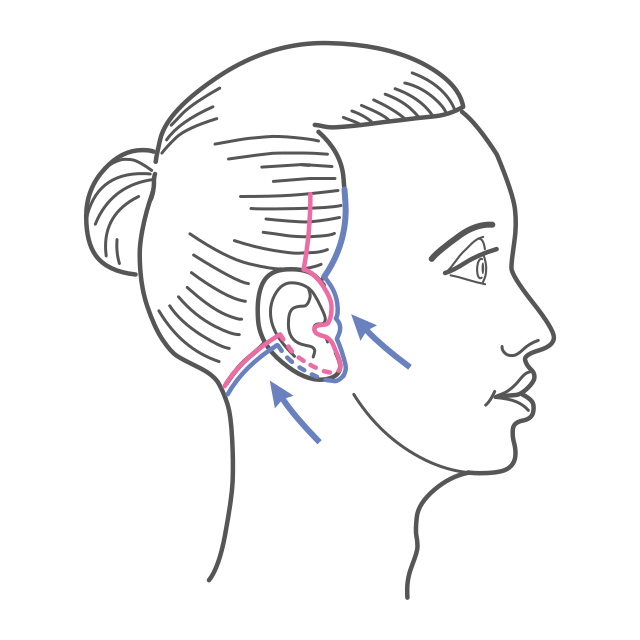
Angehoben wird abgesunkenes Gewebe; an der Hautbeschaffenheit selbst ändert der Eingriff nichts. Pigmentflecken, feine Fältchen oder verlorenes Volumen bleiben davon unberührt und werden gegebenenfalls mit anderen Verfahren angegangen, etwa Eigenfett oder einer Lidstraffung. Welcher Umfang sinnvoll ist, hängt davon ab, welche Gesichtsregionen betroffen sind; nicht jeder Befund braucht eine vollständige Straffung. Die Schnitte verlaufen entlang des Haaransatzes und um das Ohr, wo die Narben später wenig auffallen. Das Beratungsgespräch findet in Frankfurt statt, der Eingriff in Oberursel.
Advantages · Who is it for? · Mini-Lift vs. SMAS Lift · Procedure · Aftercare Timeline · Risks · Costs · Alternatives · Team · FAQ · Date
Maybe you know the feeling: You look in the mirror and see sagging cheeks, deep wrinkles, and a blurred jawline—as if gravity had pulled you down a bit. That’s not you.
„Ich wollte nicht 20 Jahre jünger aussehen. Ich wollte einfach wieder meine eigene Gesichtskontur sehen – klar und definiert, so wie ich mich innerlich fühle.“ – So beschreibt eine unserer Patientinnen ihr Gefühl vor der Behandlung.
A facelift isn't about conforming to an ideal of beauty. It’s about turning back the clock a little—not to a stranger’s face, but to your own. Without sagging skin that blurs your features. Without the heaviness that makes your face look older than you feel.
We’ll be with you every step of the way—with our experience, tact, and the goal of helping you maintain your natural radiance for years to come.
Medically reviewed ✓
Written by Dr. med. Zeynep Potente
Board-Certified Specialist in Plastic and Aesthetic Surgery
✓ Member of the DGPRÄC (German Society of Plastic, Reconstructive, and Aesthetic Surgeons)
EBOPRAS – European Board of Plastic, Reconstructive and Aesthetic Surgery - ebopras.eu
✓ Over 20 years of experience in plastic surgery
✓ Specialization: Facial surgery and facelifts
📅 Last updated: 11. August 2026
⭐⭐⭐⭐⭐ 5.0 on Google · over 300 more reviews on Jameda
✓ Member of the DGPRÄC (German Society of Plastic, Reconstructive, and Aesthetic Surgeons)
✓ Our own certified operating rooms in Frankfurt and Oberursel
✓ Restoring Clear Contours – The jawline and face shape are defined
✓ Long-lasting – The results last 7 to 10 years or longer
✓ Natural Look – No mask-like features—you remain recognizable as yourself
✓ Deep Firming – Not just the skin, but also the muscles and connective tissue
✓ Smoothing Deep Wrinkles – Nasolabial folds, marionette lines, and the neck are tightened
✓ Looking Years Younger – Most female patients look 7 to 10 years younger
✓ Can be combined – Ideal in combination with an eyelid lift, forehead lift, or autologous fat transfer
✓ Long-term solution – Unlike fillers, which need to be reapplied every few months
If your face has lost its contour
Die Wangen hängen herab, die Kieferlinie verschwimmt, und es bilden sich sogenannte „Hamsterbäckchen“ oder „Bulldoggenfalten“. Die Haut am Hals erschlafft und wirft Falten. Ihr Gesicht wirkt müde, schwer und älter, obwohl Sie sich vital fühlen. Diese Veränderungen sind der natürliche Lauf der Zeit – Schwerkraft, Hautalterung und der Verlust von Kollagen und Elastizität wirken zusammen.
When minimally invasive treatments are no longer sufficient
Hyaluronic acid, Botox, and thread lifts have their limitations. When skin sagging is already advanced and deeper structures are affected, these methods no longer offer a permanent solution. A surgical facelift is then the only way to achieve lasting, natural results.
When is a medical evaluation advisable?
If you have pre-existing conditions such as high blood pressure, diabetes, or blood clotting disorders, a thorough preoperative examination is important. Female smokers should consistently avoid nicotine for at least 4 weeks before and after surgery, as it significantly impairs wound healing. We work closely with experienced specialists to ensure your safety.
| Aspect | Mini-Lift (Cheek Lift) | SMAS Lift (Classic Facelift) |
|---|---|---|
| Main Objective | Mild to moderate sagging | Significant sagging of the face and neck |
| Duration of surgery | 1.5–2 hours | 3–4 hours |
| Cutting Technique | Short cuts in front of or behind the ear | Longer cuts at the hairline, in front of and behind the ear |
| Layers Treated | Mainly skin | Skin + SMAS (muscle and connective tissue layer) + Neck |
| Neck Lift | Not included | Included |
| Anesthesia | Twilight sleep or general anesthesia | General anesthesia |
| Hospital Stay | 1 night | 1–2 nights |
| Recovery time | 10–14 days | 2–3 weeks |
| Shelf Life | 5–7 years | 7–10 years and older |
| Special Features | Faster healing, smaller scars | Comprehensive, Long-Lasting Rejuvenation |
| Costs starting at | 6.500 € | 9.500 € |
We take the time to listen to you. During a detailed consultation, we analyze your facial structure, discuss your goals, and create a personalized treatment plan.
What we'll discuss:
Mini-Lift (Cheek Lift):
For mild to moderate sagging, we make short incisions in front of and inside the ear. The skin is loosened, excess tissue is removed, and the cheek area is tightened. The incisions are minimal and typically heal with very little scarring. This method is particularly suitable for younger patients (ages 40 and up) or as a touch-up to a previous facelift.
SMAS Lift (classic facelift):
For comprehensive rejuvenation, we make incisions at the hairline at the temples, in front of the ear along the natural skin folds, and behind the ear. The skin is released over a large area. The key is to tighten the SMAS—a layer of muscle and connective tissue beneath the skin. This layer is lifted, tightened, and secured. Excess skin is removed, the skin is gently tightened (without overstretching it), and sutured. The neck is also tightened as part of the procedure. This technique delivers the most natural and long-lasting results.
Where will the surgery take place?
In our own certified operating rooms in Oberursel (Oberhöchstadter Str. 8). From preoperative preparation through the surgery to the recovery room—everything under one roof.
Our specialist in anesthesiology, Dr. med. Livia Köhler, will personally care for you throughout the entire surgery.
The First 48 Hours: Hospital Stay and Rest
After the surgery, you will stay at our clinic for 1 to 2 nights for observation. Your face will be stabilized with a protective head bandage that minimizes swelling. In the first few days, small drains may be inserted to remove wound fluid—these will be removed after 1 to 3 days. Keep your head elevated and avoid sudden movements. Swelling and bruising are completely normal.
Days 3–7: Initial Recovery at Home
The head bandage will be replaced after 24 to 48 hours with a lighter compression bandage, which you will wear for the first week. Starting on the third day, you may shower carefully and wash your hair with a mild shampoo. Cool your face regularly with cold compresses. The swelling is at its worst now but will subside each day. Rest is crucial at this time—avoid strenuous activities, loud talking, and laughing.
Week 2: Suture Removal and Visibility
The stitches are removed after 7 to 10 days. Most of the swelling and bruising will have already subsided significantly. You can use makeup to make yourself presentable again, even if slight residual swelling may still be visible. Many patients return to work after 10 to 14 days.
Weeks 3–4: Increasing Mobility
After 3 to 4 weeks, most patients feel like themselves again. The first positive changes in facial contours are clearly visible. Light walks and gentle activities are permitted. The scars are reddish at first but fade over the course of several months into fine, barely visible lines.
Months 2–3: Complete healing
After 6 to 8 weeks, the swelling will have completely subsided. You can resume exercising and carry out all your daily activities as usual. Your skin may still feel slightly tight, but this will return to normal over the course of several months.
Sports, Sun, and Sauna: Take a 6–8-week break
Give your body at least 6 weeks off from intense exercise. Light walks are possible starting in week 2. You should avoid saunas, swimming pools, and direct sunlight for 6 weeks. Protect the scars from the sun for 12 months by using sunscreen with an SPF of 50+ or higher.
The final result after 3–6 months
The full, final results of your facelift will be visible after 3 to 6 months—by then, healing will be complete, all swelling will have subsided, the scars will have faded, and you’ll be able to fully enjoy your rejuvenated, natural appearance.
As with any surgical procedure, there are potential risks associated with a facelift. We will discuss these with you in detail:
Common (temporary):
Rare:
Very rare:
Our experienced team minimizes these risks through precise surgical techniques, careful patient selection, and close follow-up care. It is especially important that you consistently avoid nicotine before and after surgery.
The cost depends on the scope of treatment, the method chosen, and any combinations.
| Performance | Costs starting at |
|---|---|
| Mini-Lift (Cheek Lift) | 6.500 € |
| SMAS Lift (Classic Facelift) | 9.500 € |
| SMAS Lift, including neck lift | 11.000 € |
| Additionally: Forehead lift | approx. 2,500 € |
| Additionally: Autologous Fat Transfer | approx. 1,800–2,500 € |
| Hospital Stay | 500 € pro Nacht, nicht im OP-Preis enthalten |
| General anesthesia | 1.000 €, nicht im OP-Preis enthalten |
Im Preis enthalten
Zusätzlich zum Preis
Cash acquisition?
A facelift is generally considered a cosmetic procedure and is not covered by health insurance. Exception: In cases of functional limitations resulting from significant weight loss or accidents, coverage may be requested on a case-by-case basis.
Alternatives to Surgery
Depending on the extent of the sagging, other treatments may also help:
More about non-surgical treatments
Useful Combinations
The results can often be improved with complementary treatments:
We provide honest, personalized advice—only what truly suits you and meets your needs.

You will stay at the clinic for 1–2 nights. After 10–14 days, most patients are able to resume social activities. Office work is possible after 2–3 weeks, and exercise after 6 weeks. You will see the final results after 3–6 months.
General anesthesia is typically used for a classic SMAS facelift. A mini-lift can also be performed under twilight sedation. We will discuss with you which type of anesthesia is best suited for your case.
The incisions are carefully placed in natural skin folds, along the hairline, and behind the ear. After 6–12 months, the scars are barely visible in most patients. Proper scar care and sun protection support the healing process.
Generally, no, since this is a cosmetic procedure. Coverage may be requested only in cases of functional limitations resulting from accidents or significant weight loss.
A mini-lift lasts 5–7 years, while a classic SMAS facelift lasts 7–10 years or longer. The natural aging process continues, but you’re starting from a younger baseline. A healthy lifestyle and sun protection help prolong the results.
No, not with modern surgical techniques. We tighten the deeper layers (the SMAS layer), not just the skin. The result is natural, and facial expressions are fully preserved. A mask-like appearance only occurs with outdated techniques or excessive skin tightening.
Most female patients are between the ages of 45 and 65. It is not age that is the deciding factor, but rather the degree of sagging. For mild signs of sagging, a mini-lift may be appropriate starting at age 40; for pronounced sagging, a traditional facelift may be appropriate starting at age 50.
Yes, many female patients undergo a second facelift after 7–10 years. During the second procedure, usually only the skin is tightened, since the SMAS layer is still intact. The scars are in the same places.
OP duration: 1.5–4 hours (depending on the scope)
Type of anesthesia: Twilight sleep (mini-lift) or general anesthesia (SMAS lift)
Hospitalization: 1–2 nights as an inpatient
Incapacity for work: 2–3 weeks (office work), 4–6 weeks (physical work)
Sport: after 6–8 weeks
Socially Acceptable: after 10–14 days
Scarring: At the hairline, in front of and behind the ear (well hidden)
Shelf life: 5–7 years (mini-lift), 7–10+ years (SMAS lift)
Final result visible: after 3–6 months
Costs: Starting at €6,500 (Mini-Lift), starting at €9,500 (SMAS-Lift)
Acquisition of a pharmacy: Only when medically indicated
Follow-up care included: Yes, all follow-up appointments
Write to us! We will be happy to advise you!