- Oberhöchstadter Str. 8, 61440 Oberursel
- 06171 591 91
- Am Salzhaus 6, 60311 Frankfurt am Main
- 069 920 380 90

- Oberhöchstadter Str. 8, 61440 Oberursel
- 06171 591 91
- Am Salzhaus 6, 60311 Frankfurt am Main
- 069 920 380 90
Patient story · Reconstruction
After a gastric bypass, a patient lost 58 kilograms. She was left with excess skin that caused her pain and severely limited her during exercise and at work. Together with Dr. med. Zeynep Potente, she planned lifts of five areas of her body, spread over several surgeries. The image gallery tells her story in seven slides and a video.
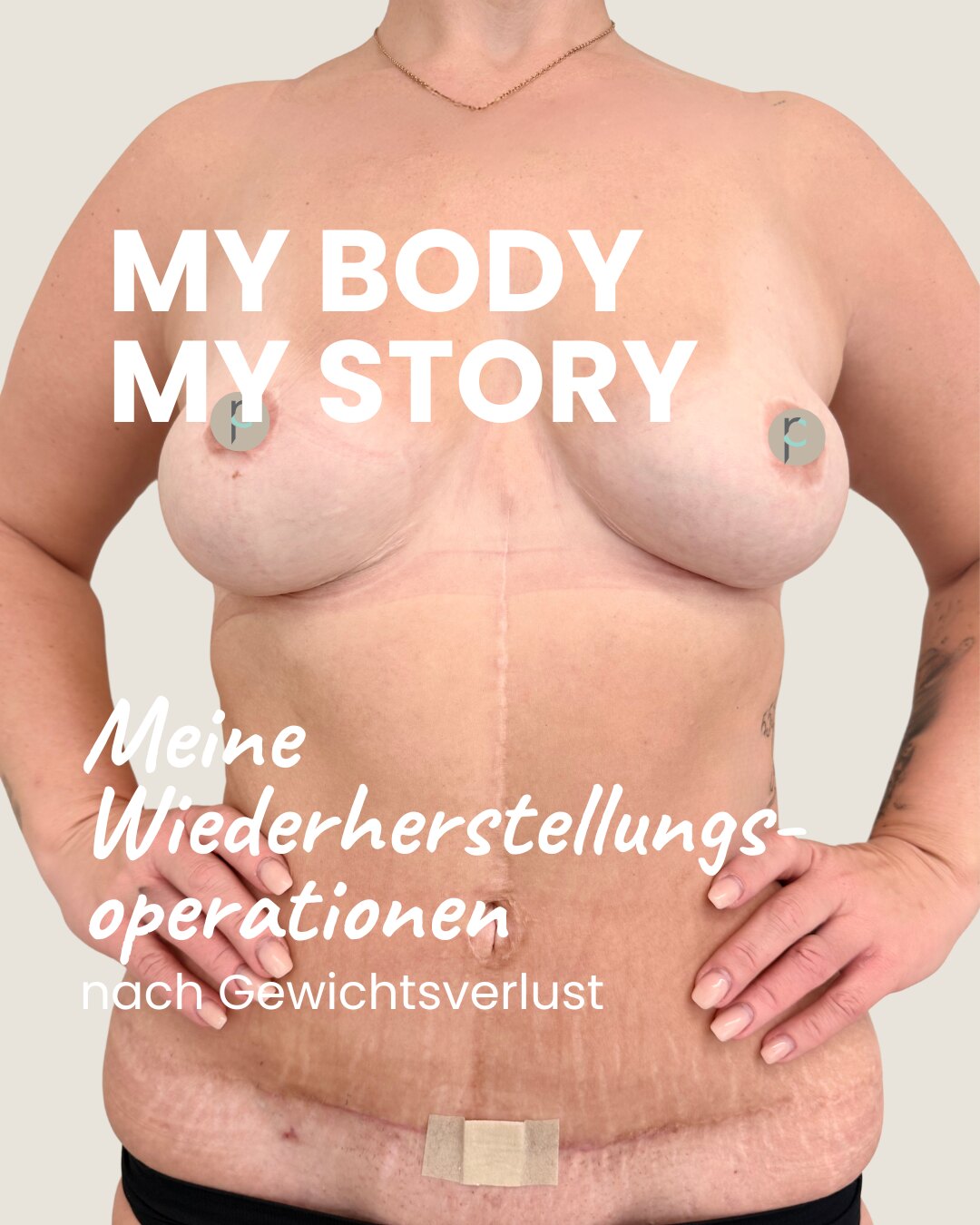
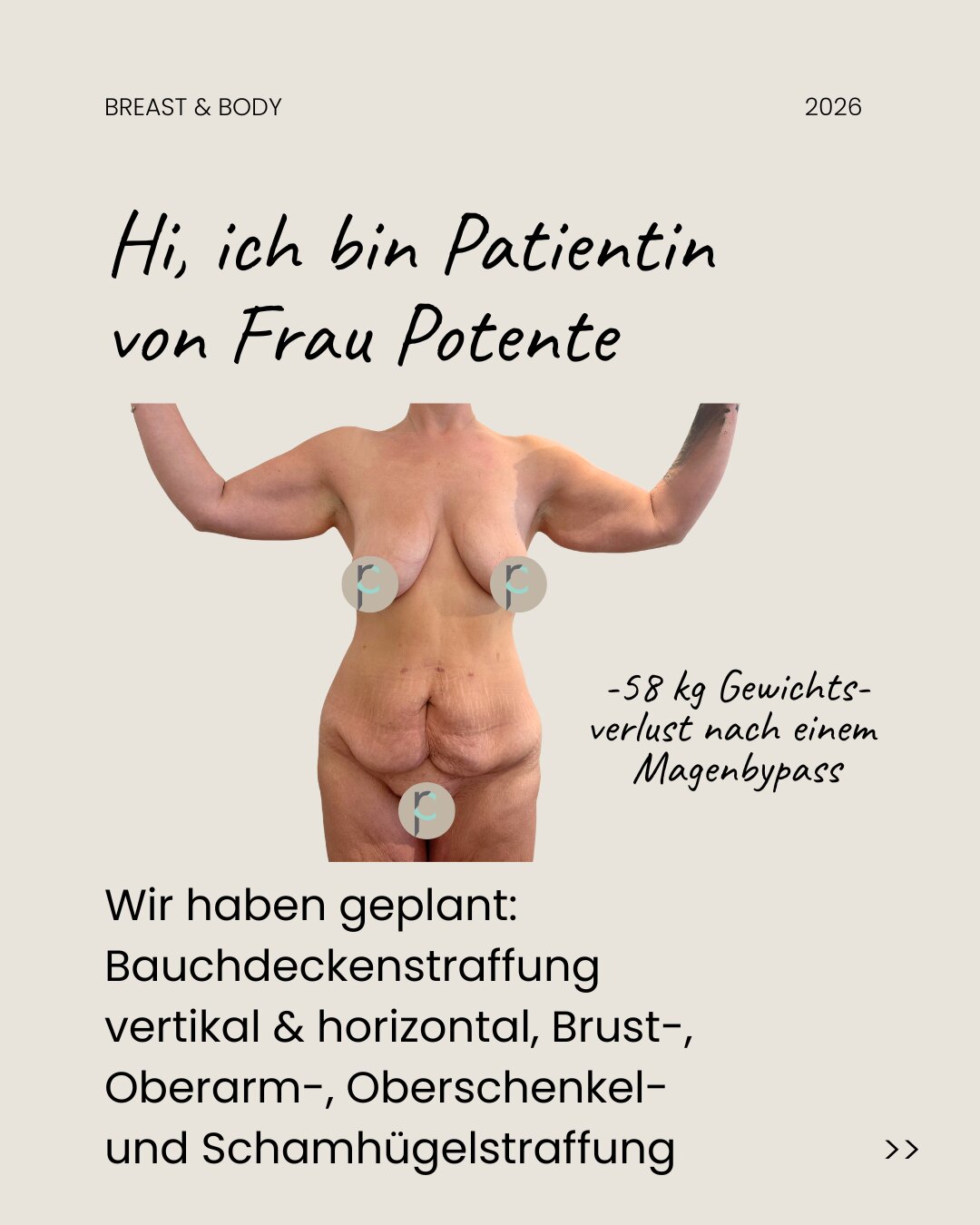

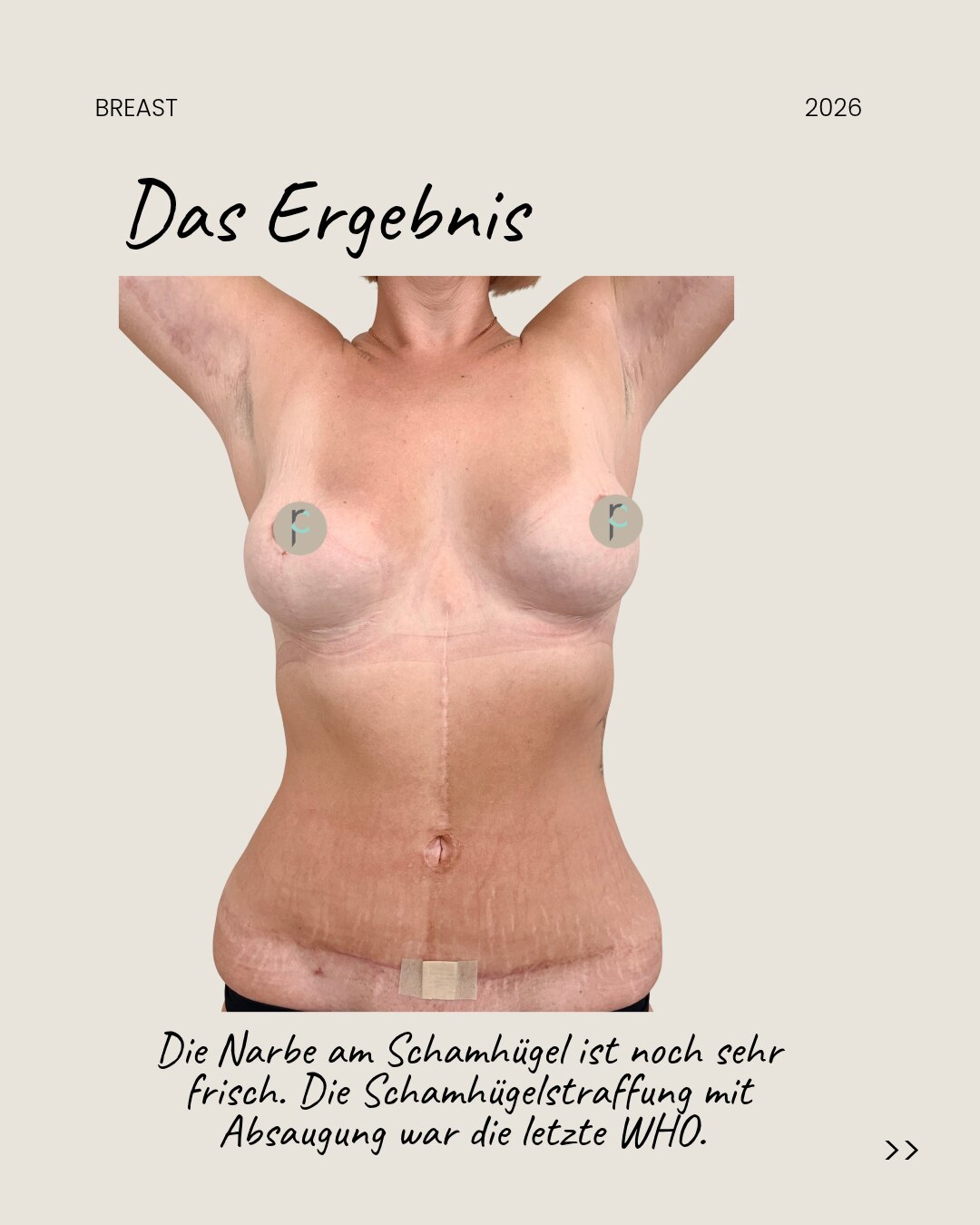

The slides present her own words; the last one looks back on the treatment. Six slides show her unclothed body: three before the surgeries, one after the tummy tuck and before the breast and upper arm lift, and two afterward. The photos taken afterward do not show a final result; in her words, the scar on the pubic mound is still very fresh.
The ten-second video shows her in underwear after the surgeries, facing the camera with her hands on her hips, then with her arms raised and half turned to the side.
In the photo on the findings slide, she is holding her abdominal apron with both hands. Skin that was stretched for years retracts only to a limited extent after significant weight loss. On the abdomen, it often remains as an apron that hangs down over the pubic area. Under the apron, the skin stays warm and moist and easily becomes inflamed; on the arms and thighs, the skin chafes with movement. This is explained in more detail in the article Abdominoplasty after major weight loss.
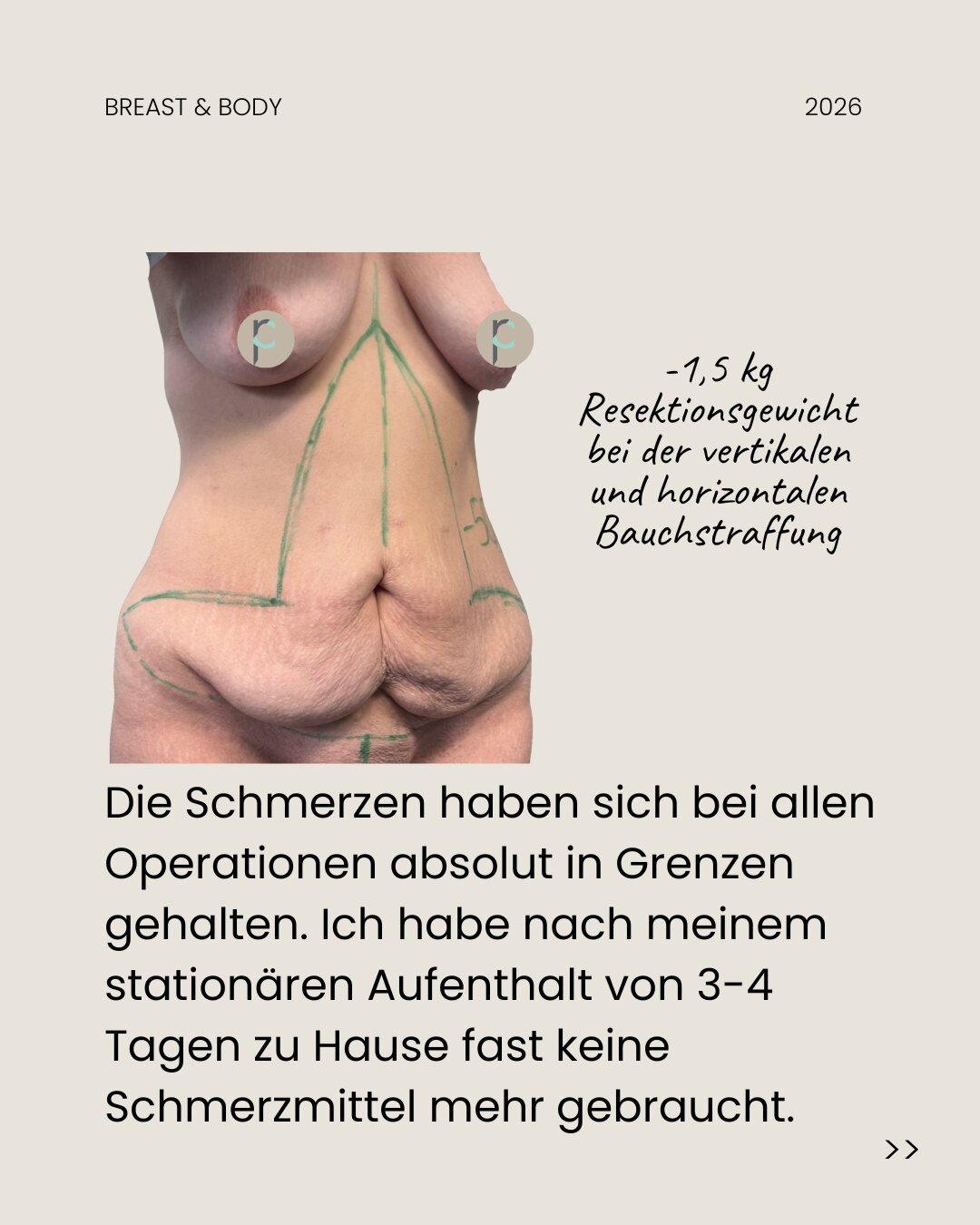
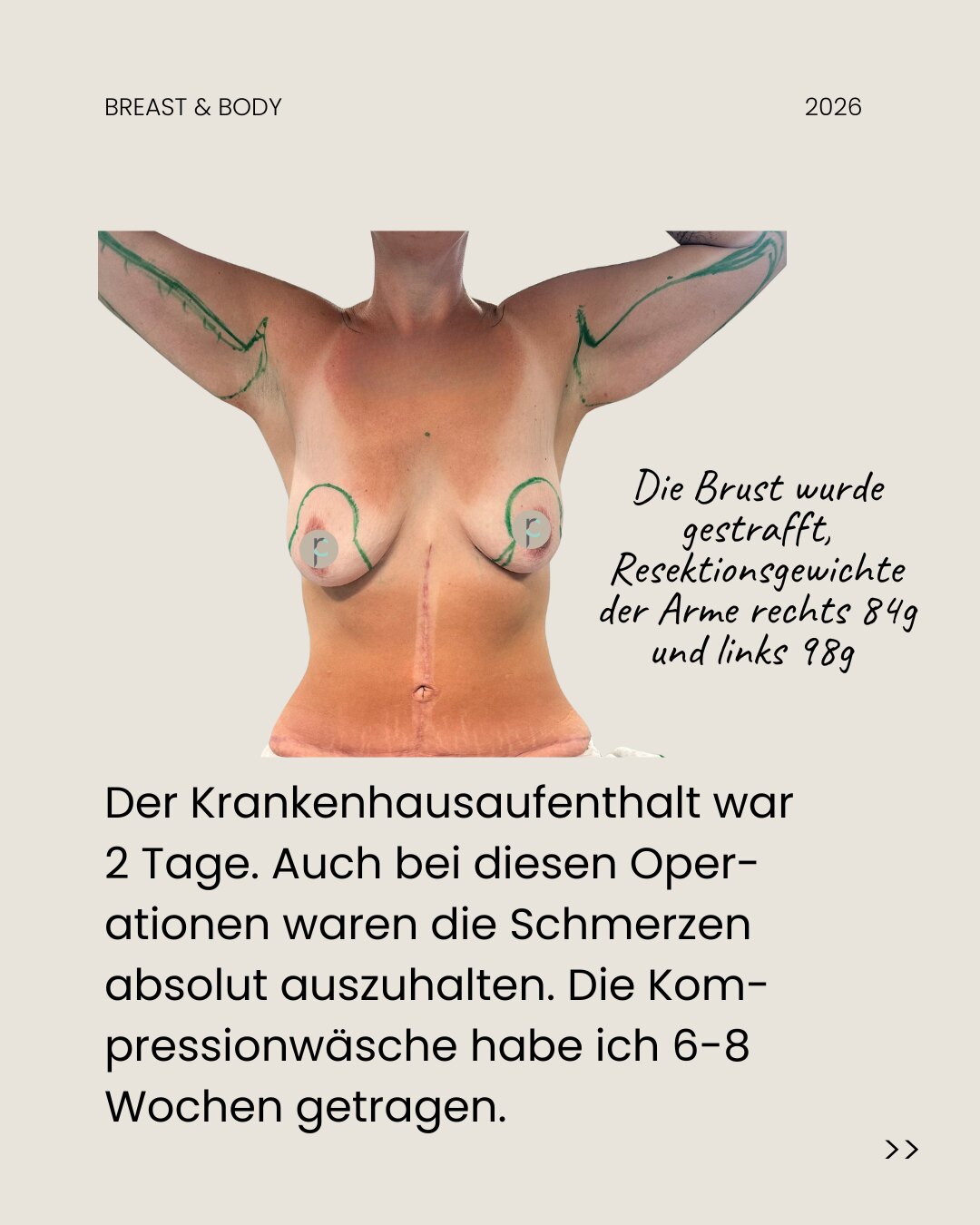
The plan called for a vertical and horizontal tummy tuck, plus a Breast lift, Upper Arm Lift, Thigh lift and Pubic mound lift. “Vertical and horizontal” means that a vertical incision along the midline is added to the horizontal incision just above the pubic hairline when there is also excess skin from side to side. This midline scar cannot be concealed by underwear. The slides document the lifts of the abdomen, breasts, and upper arms, and of the pubic mound with additional liposuction.
According to her, 1.5 kilograms of tissue were removed from the abdomen, and from the upper arms 84 grams on the right and 98 grams on the left. Compared with the 58 kilograms she had lost beforehand, that is not much: a lift mainly removes excess skin. It is not a substitute for losing weight.
According to her, she stayed in the hospital for three to four days after the tummy tuck and for two days after the breast and upper arm lift. She writes that the pain was manageable after each of the surgeries and that after the abdominal surgery she hardly needed any pain medication once she was home. She wore compression garments for six to eight weeks.
Lifts after significant weight loss are major procedures in which complications are comparatively common, especially wound-healing problems.
“I felt like a balloon with the air gone out of it.”
— Patient, on the time before the surgeries
Note: This case is an individual example. Which lifts are an option and how healing progresses depend on the findings and the patient’s general health. Her statement that the pain was manageable describes her experience and cannot be generalized to other patients.
When your weight has been stable for six to twelve months and no further weight loss is planned, because further weight loss makes the skin sag again. Protein and vitamin levels should be within the normal range, as they affect wound healing. For extensive lifts, we recommend a preoperative examination by an internist.
Because the risk increases with the size of the wound area. For lifts after significant weight loss, the assessment guidelines of the Medical Service, which reviews cases for statutory health insurance, cite figures from the literature: complications in more than 30 percent of cases, most often wound-healing problems or seromas, meaning collections of wound fluid; serious complications such as postoperative bleeding, hematomas, and thrombosis with embolism, as well as seromas that require surgery, in about 10 percent. If several areas of the body are affected, the guidelines therefore recommend operating on them one after another. The breasts and upper arms are adjacent and, if the patient’s general health allows, can be lifted in a single operation; an example is shown in the article After 60 kilograms of weight loss.
Statutory health insurers cover a lift only in individual cases where the excess skin demonstrably leads to medical conditions or functional impairments, or is so disfiguring that other people would usually notice it even in everyday clothing, but not where it is solely a matter of shape or of the patient’s own perception. Examples listed in the Medical Service’s assessment guidelines include skin changes, such as inflammation, that persist after at least six months of documented specialist treatment, and limitations in intimate hygiene, urination, or movement, for example from an abdominal apron that completely covers the external genitalia when standing. The decision rests with the health insurer.
During the consultation, we examine where the skin is causing problems, which lifts are an option and in what order, and which findings count when you apply to your health insurer for coverage. Consultations are held in Frankfurt and Oberursel; we discuss in advance where the surgery will be performed.
Patient of Dr. med. Zeynep Potente · Updated on November 19, 2026