- Oberhöchstadter Str. 8, 61440 Oberursel
- 06171 591 91
- Am Salzhaus 6, 60311 Frankfurt am Main
- 069 920 380 90

- Oberhöchstadter Str. 8, 61440 Oberursel
- 06171 591 91
- Am Salzhaus 6, 60311 Frankfurt am Main
- 069 920 380 90
One Breast reduction – medical Breast Reduction Surgery – is a surgical procedure to reduce breast size. During the procedure, we carefully remove excess glandular and fatty tissue as well as excess skin, and reshape the breast.
The result: a lighter, firmer bust with harmonious proportions that suits your body and provides you with significant relief.
Often, the focus isn’t on appearance but on symptoms: neck and back pain, constriction from bra straps, or skin irritation in the inframammary fold. Whether health insurance covers part of the costs depends on the individual case and is clarified in advance. How much tissue is removed and how the nipple is repositioned depends on the initial findings and the desired size. Breastfeeding later on is possible depending on the technique and findings, but not in every case—this will be discussed during the consultation. Consultations take place in Frankfurt, and surgeries are performed in Oberursel.
Advantages · Who is it for? · Surgical Methods · Procedure · Before/After · Aftercare Timeline · Risks · Costs · Alternatives · Team · FAQ · Date
A reduction may be an option for women whose pain keeps coming back despite physical therapy and painkillers, who can hardly exercise anymore and struggle to find a bra that fits. How much tissue is removed determines the incision pattern: the vertical (I) technique works for up to about 300 g per side, and for larger reductions the inverted-T technique, which leaves an additional scar in the breast fold, may be used. If you have chronic orthopedic complaints, we recommend an orthopedic exam beforehand.

Medically reviewed ✓
Written by Dr. med. Zeynep Potente
Specialist in Plastic and Aesthetic Surgery
✓ Member of the DGPRÄC (German Society of Plastic, Reconstructive, and Aesthetic Surgeons)
EBOPRAS – European Board of Plastic, Reconstructive and Aesthetic Surgery - ebopras.eu
✓ Over 20 years of experience in plastic surgery
✓ Specialization: Breast surgery and breast reduction
📅 Last updated: August 11, 2026
⭐⭐⭐⭐⭐ 5.0 on Google · over 300 more reviews on Jameda
✓ Member of the DGPRÄC (German Society of Plastic, Reconstructive, and Aesthetic Surgeons)
✓ Our own certified operating rooms in Oberursel
✓ Physical Relief – Neck, shoulder, and back pain are relieved
✓ Greater freedom of movement – Finally, I can exercise again without restrictions
✓ Improved Posture – No more hunched posture caused by the weight of the chest
✓ No more bra constriction – Painful pressure points on the shoulders disappear
✓ Treating Skin Problems – Inflammation in the inframammary fold is a thing of the past
✓ Harmonious Proportions – The top complements your body shape
✓ More Self-Confidence – Feeling comfortable in your own skin and in your clothes
✓ Medically sound as well – If you have verifiable symptoms, your health insurance may cover the costs
If you suffer from chronic pain
The weight of your breasts causes persistent discomfort in your neck, shoulders, and back. Despite physical therapy and pain medication, the discomfort keeps coming back. Your bra straps dig in deeply and leave painful pressure marks. You hunch over to compensate for the weight—which only makes the problems worse.
If your quality of life is compromised
It’s almost impossible to exercise because your breasts restrict your movement and cause pain. You have a hard time finding bras or clothing that are both comfortable and attractive. You frequently experience skin irritation or inflammation in the crease under your breasts. You feel uncomfortable with the attention your bust attracts.
When is a medical evaluation advisable?
If you suffer from chronic orthopedic conditions, we recommend a preliminary orthopedic examination. If you have existing conditions such as diabetes or severe obesity, an internal medicine evaluation is advisable. We work closely with experienced specialists to ensure your safety.
| Aspect | I-Method (vertical incision) | T-Method (inverted T) |
|---|---|---|
| Main Objective | Moderate reduction | Significant reduction |
| Tissue Removal | Up to about 300 g per side | Over 300 g per side possible |
| Duration of surgery | 2–2.5 hours | 2–2.5 hours |
| Cutting Technique | Around the nipple + vertically downward | Around the nipple + vertically + under-breast creases | Scars | Visible in the middle, fade well | More visible, hidden in a fold | Nipple | Offset, usually with a stemmed technique | Offset, usually with a stemmed technique |
| Anesthesia | General anesthesia | General anesthesia |
| Hospital Stay | 1–2 nights | 2–3 nights |
| Recovery time | 2–3 weeks | 3–4 weeks |
| Special Features | Fewer scars, faster healing | Suitable for very large breasts |
| Costs starting at | 6.500 € | 6.500 € |
We take the time to listen to you. During a detailed consultation, we’ll discuss your needs, examine your breasts, and develop a personalized treatment plan.
What we'll discuss:
I-Method (vertical scar):
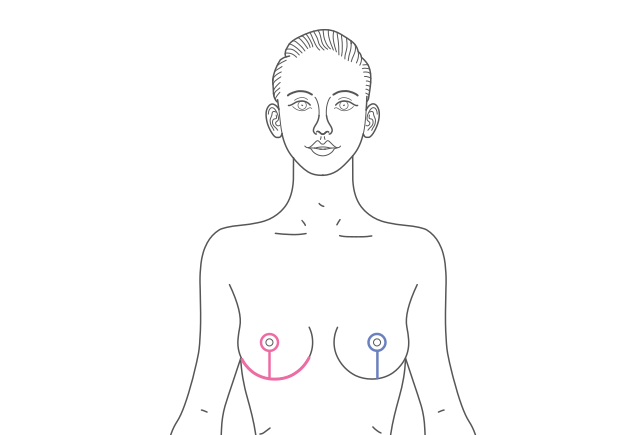
We make an incision around the nipple and extend it vertically downward to the inframammary fold. The nipple, along with its nerves and blood vessels, is repositioned higher up. Excess glandular and fatty tissue, as well as skin, are removed, and the breast is reshaped and lifted. This method is suitable for moderate breast reductions and leaves less visible scarring.
T-Method (inverted T):
For very large breasts, a horizontal incision is also made in the inframammary fold—the scar then takes the shape of an inverted T. This technique allows for more extensive tissue removal and lifting. The scar in the inframammary fold is usually not visible in everyday life.
Where will the surgery take place?
In our own certified operating rooms in Oberursel (Oberhöchstadter Str. 8). From preoperative preparation through the surgery to the recovery room—everything under one roof.
Our practice at Salzhaus 6 is located in the heart of downtown Frankfurt, a five-minute walk from Konstablerwache and Hauptwache. It is easily accessible by U-Bahn and S-Bahn from all parts of Frankfurt, as well as from Wiesbaden, Mainz, Offenbach, and the entire Rhine-Main region.
For patients from the Hochtaunus district, we also offer our practice in Oberursel.
Consultations and follow-up care can take place at either location. We perform the surgery itself in our certified operating rooms in Oberursel.
General anesthesia: Breast reduction surgery is always performed under general anesthesia so that you can sleep peacefully throughout the entire procedure and feel nothing.
Our specialist in anesthesiology, Dr. med. Livia Köhler, will personally care for you throughout the entire surgery.
These are the results for some of our patients.
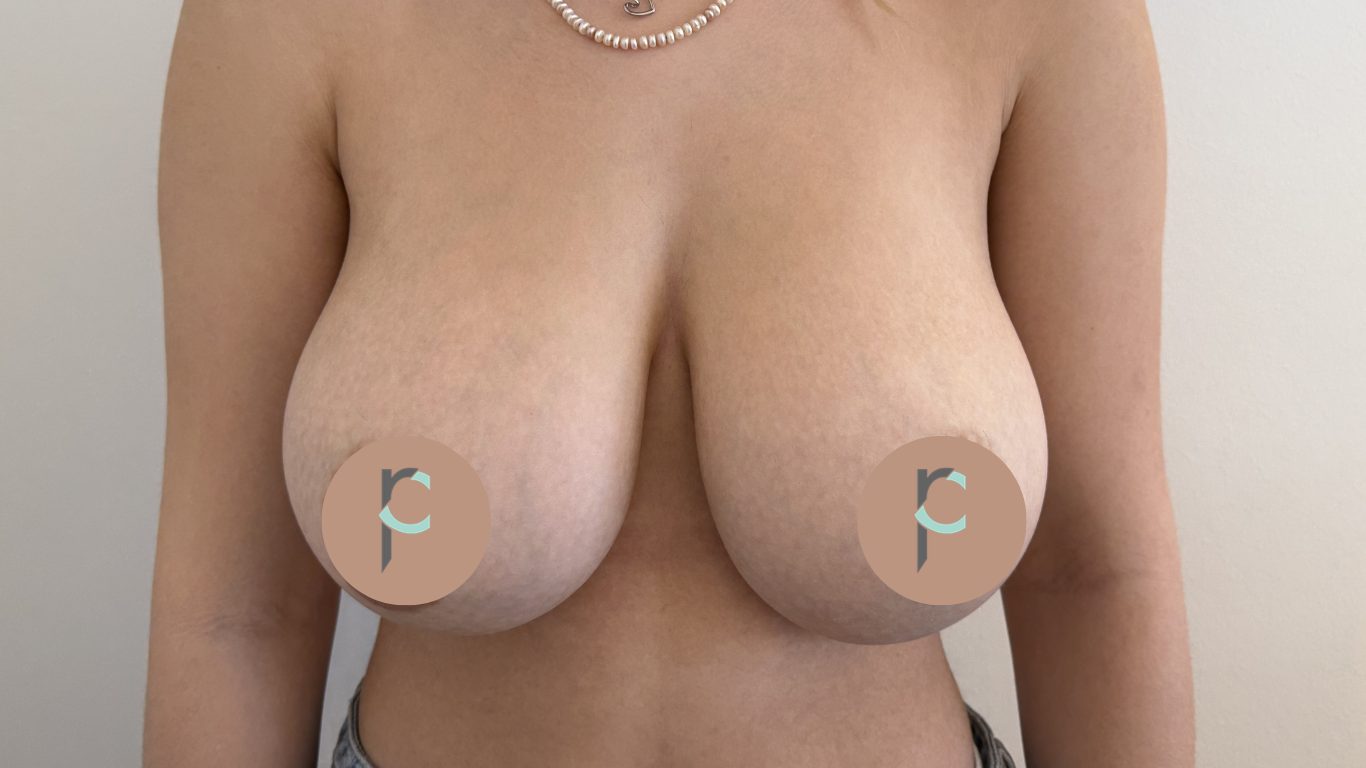
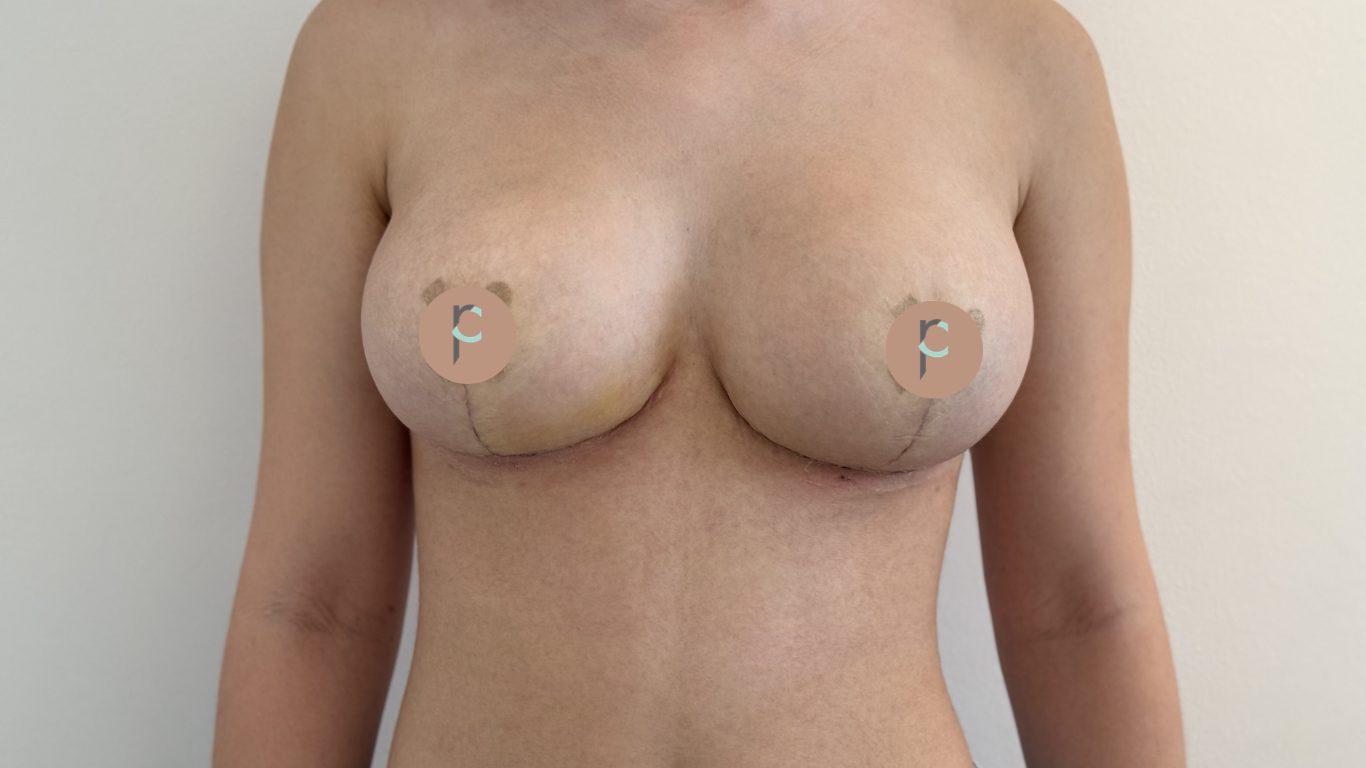
The First 48 Hours: Hospital Stay and Rest
After the surgery, you will stay at our clinic for 1 to 2 nights for observation. In the first few days, drains are usually inserted to remove fluid from the wound. These are removed after 2 to 5 days. You will be given pain medication, and a special support bra will be fitted immediately after surgery to aid healing. Rest is especially important now—keep your upper body slightly elevated.
Week 1: Getting Started at Home
Starting on the third day, you may take a shower with care—the surgical incisions should not come into direct contact with water. Short walks are important for blood circulation. You should sleep on your back and avoid lifting heavy objects. Swelling and bruising are completely normal. The support bra should be worn at all times.
Weeks 2–3: Dressing changes and suture removal
After about 2 to 3 weeks, the stitches will be removed (unless they are dissolvable). You will feel increasingly comfortable and can resume light daily activities. Office work is usually possible after 1 to 2 weeks, but you should wait another 3 to 4 weeks before resuming physically strenuous activities. You should continue to wear the support bra day and night.
Weeks 4–6: Return to Normalcy
Most patients feel largely back to normal after 3 to 4 weeks. Swelling gradually subsides, and the breast takes on its final shape. You can walk more upright again and move more freely. The support bra should be worn for a total of 6 weeks.
Sports, Sun, and Sauna: Take a 6–8-week break
Give your body at least 6 weeks off from sports that put strain on the chest (jogging, tennis, strength training). Light walks are possible sooner. You should avoid saunas and swimming pools for at least 6 weeks. Very important: Protect the scars from direct sunlight for at least 12 months and consistently use a high-SPF sunscreen with an SPF of 50 or higher.
Scar Care Starting in Week 3
Once the wounds have completely closed, scar care begins. Applying special scar ointments or silicone gel daily, as well as gently massaging the scars, promotes healing. The scars are red at first and fade over 6 to 12 months into inconspicuous, light-colored lines.
The final result after 6–12 months
The full final results of your breast reduction surgery will be visible after 6 to 12 months—by then, healing will be complete, all swelling will have subsided, and the scars will have faded. You’ll be able to fully enjoy your newfound lightness.
As with any surgical procedure, there are potential risks associated with breast reduction surgery. We will discuss these with you in detail:
Common (temporary):
Rare:
Very rare:
Our experienced team minimizes these risks through precise surgical techniques, careful patient selection, individualized planning, and close follow-up care.
The costs depend on the individual diagnosis, the extent of the treatment, and the surgical method chosen.
| Performance | Costs starting at |
|---|---|
| Breast Reduction (I-Method) | 6.500 € |
| Breast Reduction (T-Method) | 6.500 € |
| Additionally: Correction of severe asymmetry | individual |
| Hospital Stay | 500 € per night, not included in the surgery price |
| General anesthesia | 1,000 €, not included in the surgery price |
| Support Bra | approx. 100–150 € (sold separately) |
Included in the price
In addition to the price
Coverage by Health Insurance Plans When Medically Necessary
If your large breasts are causing demonstrable health problems, treatment may be medically necessary. In that case:
We would be happy to advise you on this matter and assist you with the application process by providing all the necessary documents and expert reports.
Alternatives to Surgery
In some cases, conservative measures may be helpful at first:
These measures can alleviate the symptoms, but they do not eliminate the underlying cause of true macromastia.
Useful Combinations
The results can often be improved with complementary treatments:
We provide honest, personalized advice—only what truly suits you and meets your needs.




You will stay at the clinic for 1–2 nights. Most patients are able to return to work after 1–2 weeks (for office work) and after 3–4 weeks for physical labor. You can resume sports activities after 6–8 weeks. Full recovery takes 6–12 months.
Yes, breast reduction surgery leaves scars. These run around the nipple and vertically downward; with the T-incision method, there is an additional scar in the inframammary fold. The scars are red at first but fade over 6–12 months into inconspicuous, light-colored lines. They are usually not visible in a bra or bikini.
If there is a medical necessity and corresponding symptoms, coverage of costs may be possible. Requirements include: verifiable chronic symptoms (orthopedic evaluation), and unsuccessful conservative treatments. The health insurance provider makes this decision on a case-by-case basis, regardless of the chosen treatment method. During the consultation, we’ll discuss which documents are necessary and assist you with the application process.
If your weight remains stable, the results are permanent. However, significant weight fluctuations, pregnancies, or hormonal changes can cause your breasts to enlarge again.
Breast reduction surgery can affect your ability to breastfeed because glandular tissue is removed. With the pedicle technique, the nerves and blood vessels leading to the nipple are usually preserved, which increases your chances of breastfeeding. However, there is no guarantee. If you have not yet finished planning your family, we should take this into account when planning your surgery.
You won’t feel anything during the surgery because you’ll be under general anesthesia. After the surgery, a feeling of tightness and moderate pain are normal and can be easily managed with medication. Most patients describe the pain as quite tolerable, and it is more than offset by the immediate relief they experience.
In principle, growth should be complete, usually by age 18. If you are experiencing significant distress and your breast growth is complete, surgery may be considered earlier. There is no upper age limit, as long as you are healthy and fit for surgery.
In cases of significant weight gain, hormonal changes (pregnancy, menopause), or another pregnancy, the reduced breast size may increase again. However, if your weight remains stable, the results are permanent.
OP duration: 2–2.5 hours
Type of anesthesia: General anesthesia
Hospitalization: 1–2 nights as an inpatient
Incapacity for work: 1–4 weeks (depending on the job)
Sport: after 4–8 weeks
Scarring: Around the nipple + vertically (+ horizontally for the T-method)
Shelf life: Sustained at a stable weight
Costs: starting at 6,500 €
Acquisition of a pharmacy: Possible if medically necessary
Follow-up care included: Yes, all follow-up appointments
Write to us! We will be happy to advise you!