- Oberhöchstadter Str. 8, 61440 Oberursel
- 06171 591 91
- Am Salzhaus 6, 60311 Frankfurt am Main
- 069 920 380 90

- Oberhöchstadter Str. 8, 61440 Oberursel
- 06171 591 91
- Am Salzhaus 6, 60311 Frankfurt am Main
- 069 920 380 90
A Implant Replacement is a surgical procedure in which existing breast implants are replaced with new ones. During the procedure, the old implant is removed, the surrounding capsule is treated if necessary, and a new, modern implant is inserted. Often, the implant is also repositioned, or the breast is additionally lifted.
The result: breasts that suit you again—aesthetically harmonious and free of discomfort.
Implants do not have a fixed expiration date. Replacement is not necessary after a set period of time, but only when there is a reason: a hardened capsule, a defect, tissue changes following pregnancy or weight fluctuation, or a desire for a different size. The procedure also offers the opportunity to change the size, shape, or position of the implant. The findings will determine whether a lift is advisable: If the skin has stretched over the years, simply replacing the implant will not achieve the desired shape. Consultations take place in Frankfurt, and surgeries are performed in Oberursel.
Advantages · Who is it for? · Cosmetic vs. Medical Replacement · Procedure · Aftercare Timeline · Risks · Costs · Alternatives · Team · FAQ · Date
With capsular contracture or a ruptured or shifted implant, all or part of the capsule is often removed as well; the surgery then takes two to three hours, while a purely aesthetic exchange takes one to two. Very old implants, especially those from before 1990, and PIP implants should be replaced as a precaution. If damage is suspected, an ultrasound or MRI comes first. Health insurance covers at most the removal, and only when it is medically necessary.

Medically reviewed ✓
Written by Dr. med. Zeynep Potente
Specialist in Plastic and Aesthetic Surgery
✓ Member of the DGPRÄC (German Society of Plastic, Reconstructive, and Aesthetic Surgeons)
EBOPRAS – European Board of Plastic, Reconstructive and Aesthetic Surgery - ebopras.eu
✓ Over 20 years of experience in plastic surgery
✓ Specialization: Breast surgery and revision surgery
📅 Last updated: August 11, 2026
⭐⭐⭐⭐⭐ 5.0 on Google · over 300 more reviews on Jameda
✓ Member of the DGPRÄC (German Society of Plastic, Reconstructive, and Aesthetic Surgeons)
✓ Our own certified operating rooms in Oberursel
✓ Adapting to Life Changes – You can choose a new size and shape
✓ Replacement with modern implants – Higher-quality, more durable materials
✓ Correcting Problems – Capsular fibrosis, rotation, or displacement are corrected
✓ Combination with streamlining – Sagging skin is tightened at the same time
✓ Using Old Scars – Usually no new scars are necessary
✓ Security – Old or damaged implants are replaced
✓ Harmonious Proportions – Your breasts will once again be in proportion to your current body
✓ Greater Well-Being – Symptoms and discomfort disappear
If you're looking to make cosmetic changes
Your preferences have changed—you’d like larger, smaller, or differently shaped implants. After pregnancy, breastfeeding, or weight fluctuations, your breasts have changed, and the implants no longer harmonize with your proportions. Your breasts have sagged, and you’d like to combine the implant replacement with a breast lift. Or perhaps you have older, round implants and now want the more natural look of anatomical implants.
If there are medical reasons
You have developed capsular fibrosis—your breast feels hard, is painful, or is misshapen. Your implant is damaged (ruptured) or shows signs of aging. The implant has shifted or rotated. You have very old implants (especially those from before 1990 or those involved in the PIP scandal) that should be replaced as a precaution. Or you have developed inflammation, infections, or other complications.
When is a medical evaluation advisable?
If you have pre-existing conditions such as diabetes, blood clotting disorders, or autoimmune diseases, a thorough preoperative evaluation is important. If implant damage is suspected, we recommend an ultrasound or MRI exam. Female smokers should abstain from nicotine for at least 4 weeks before and after surgery. We work closely with experienced specialists to ensure your safety.
| Aspect | Aesthetic Change | Medical Transfer |
|---|---|---|
| Main Objective | Preferred size, preferred shape, based on body changes | Capsular fibrosis, implant rupture, displacement, inflammation |
| Effort | Usually straightforward | Often more complex (requires capsule removal) |
| Duration of surgery | 1–2 hours | 2–3 hours |
| Capsule Treatment | The capsule often remains intact | Complete or partial removal of the capsule (capsulotomy) | New Implant Position | Optional | Frequently Recommended (Change of Location) | Combination with streamlining | Frequently Requested | Sometimes necessary |
| Anesthesia | General anesthesia | General anesthesia |
| Hospital Stay | 1–2 nights | 1–2 nights |
| Recovery time | 2–3 weeks | 2–4 weeks |
| Costs starting at | 4.500 € | 6.500 € |
| Cashier Takeover | No | In some cases, partially (removal only) |
We take the time to listen to you. During an in-depth consultation, we’ll discuss the reasons behind your desire to switch, assess your current situation, and develop a personalized treatment plan.
What we'll discuss:
Access via an old scar:
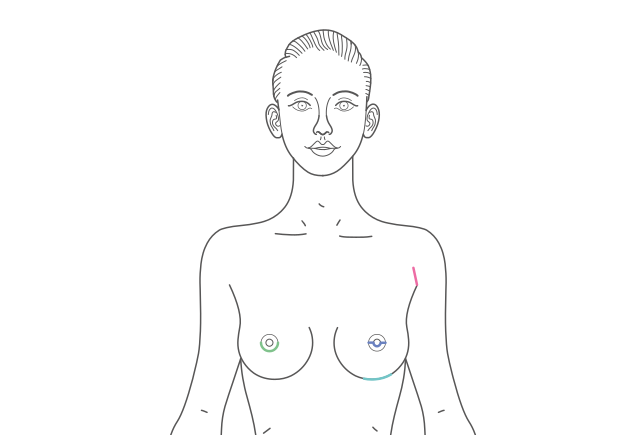
Whenever possible, we use the existing scar (usually in the inframammary fold) to avoid creating additional scars. This is usually feasible and minimizes trauma to the tissue.
Removal of the old implant:
The old implant is carefully removed. If the capsule is intact, it can often be left in place. In cases of capsular contracture, hardening, or inflammation, we perform a partial or complete removal of the capsule (capsulectomy). In cases of severe capsular contracture, the implant is removed in one piece along with the hardened capsule (total implant capsulectomy).
New implant position (optional):
It is often advisable to change the position of the new implant—for example, from above the muscle (subglandular) to below the muscle (submuscular) or using the dual-plane technique. This promotes tissue regeneration and can reduce the risk of recurrent capsular fibrosis.
Placement of the new implant:
The new, modern implant is positioned precisely. Either the existing implant pocket is used, or a new pocket is created. If necessary, a breast lift is performed at the same time to remove sagging skin and raise the nipple.
Where will the surgery take place?
In our own certified operating rooms in Oberursel (Oberhöchstadter Str. 8). From preoperative preparation through the surgery to the recovery room—everything under one roof.
General anesthesia: Always required when replacing an implant
Our specialist in anesthesiology, Dr. med. Livia Köhler, will personally care for you throughout the entire surgery.
The First 48 Hours: Hospital Stay and Rest
After the surgery, you will stay at our clinic for 1 to 2 nights for observation. A special support bra will be put on immediately after surgery to stabilize the breast. In the first few days, you may experience a feeling of tightness, mild pain, and swelling—this is completely normal. Keep your upper body slightly elevated and avoid sudden movements.
Days 3–7: Mobilization at Home
Starting on the third day, you may take a shower with caution. The support bra must be worn at all times. Short walks are important; strenuous activities should be avoided. Do not lift heavy objects (over 5 kg) or make overhead movements. The swelling will subside each day.
Week 2: Suture Removal
The stitches are removed after 7 to 10 days (unless they are dissolvable). Most patients feel increasingly comfortable and can resume light office work. The support bra should continue to be worn day and night.
Weeks 3–6: Return to Normalcy
After 2 to 3 weeks, you’ll be largely mobile again. At first, the breast will sit a little higher and feel firm—it will “settle” into its final position over the coming weeks. The support bra should be worn for a total of 6 weeks. After 4 weeks, you can go back to wearing a regular bra.
Sports, Sun, and Sauna: Take a 6–8-week break
Give your body at least 6 weeks off from exercise that puts strain on the chest (jogging, upper-body strength training). Light walks are possible starting in week 2. You should avoid saunas and swimming pools for 6 weeks. Protect the scars from sunlight for 12 months by using sunscreen with an SPF of 50+ or higher.
The final result after 3–6 months
The full final results of your implant replacement will be visible after 3 to 6 months—by then, the new implants will have settled into their final position, all swelling will have subsided, and you’ll be able to fully enjoy your new breasts.
As with any surgical procedure, there are potential risks associated with implant replacement. We will discuss these with you in detail:
Common (temporary):
Rare:
Very rare:
Our experienced team minimizes these risks through precise surgical techniques, the use of high-quality, state-of-the-art implants, and close follow-up care. The advantage of a revision procedure is that we can learn from our experience with the initial surgery and make improvements.
The cost depends on the reason for the replacement, the amount of work involved, whether the implant needs to be removed, and any combinations of procedures.
| Performance | Costs starting at |
|---|---|
| Simple Implant Replacement (Aesthetic) | 4.500 € |
| Implant Replacement with Capsule Removal | 6.500 € |
| Implant Replacement + Breast Lift | starting at 7,500 € |
| Implant Replacement with Position Change | starting at 5,000 € |
| Hospital Stay | 500 € per night, not included in the surgery price |
| General anesthesia | 1,000 €, not included in the surgery price |
| Support Bra | approx. 100–150 € (sold separately) |
Included in the price
In addition to the price
Cash acquisition?
Implant replacement is generally a private service. Exceptions:
We will assist you in submitting your application with the necessary documentation.
Alternatives to Implant Replacement
Depending on the situation, other options may also be appropriate:
Useful Combinations
The results can often be improved with complementary treatments:
We provide honest, personalized advice—only what truly suits you and meets your needs.




You will stay at the clinic for 1–2 nights. After 2–3 weeks, most patients are able to return to work, and after 6 weeks, they can resume exercise. You will see the final results after 3–6 months.
Generally, no. We use the existing scar (usually in the inframammary fold) as the access point. Additional scars may result only if a breast lift is performed at the same time.
Modern implants are durable and do not need to be replaced on a routine basis. Many manufacturers offer a lifetime warranty. Replacement is necessary only in the event of complications (capsular fibrosis, rupture, aesthetic concerns) or for very old implants (manufactured before 1990).
The body forms a natural capsule of connective tissue around each implant. In cases of capsular fibrosis, this capsule hardens excessively. The breast feels hard, may be painful, or may become misshapen. In this case, replacement with capsule removal is recommended.
See also: Difference from Breast Implant Illness
Yes, absolutely. Many patients want a different size when they switch—often larger, but sometimes smaller as well, for a more natural look or to reduce weight.
Only in exceptional cases, and only for the removal of the old implants, not the new ones. This is subject to a medical necessity (capsular fibrosis, rupture, inflammation) with appropriate documentation. Coverage of costs is determined on a case-by-case basis; there is no uniform policy.
It can be more complex, especially if capsule removal is necessary or if scar tissue is present. However, with experienced surgeons, the procedure usually goes well. The advantage: We can learn from the initial surgery and make improvements (e.g., repositioning the implant to prevent recurrent capsular fibrosis).
Yes, both breasts are always operated on at the same time to achieve a symmetrical result. This is more efficient and saves you from having to undergo a second surgery.
Modern 5th-generation implants with a textured (microtextured) or smooth surface and highly cohesive silicone gel are extremely durable and safe. We use only certified implants from renowned manufacturers (Motiva, Mentor, Polytech). During your consultation, we’ll discuss which ones are best suited for you.
OP duration: 1–3 hours (depending on the effort required)
Type of anesthesia: General anesthesia
Hospitalization: 1–2 nights as an inpatient
Incapacity for work: 2–3 weeks (depending on the job)
Sport: after 6–8 weeks
Socially Acceptable: after 2–3 weeks
Scarring: Mostly using old scars (no new ones)
Lifespan of new implants: 10–20 years or longer, often for life
Final result visible: after 3–6 months
Costs: Starting at €4,500 (simple replacement), starting at €6,500 (with capsule removal)
Acquisition of a pharmacy: Removal only when medically indicated; new implants themselves
Follow-up care included: Yes, all follow-up appointments
Write to us! We will be happy to advise you!