- Oberhöchstadter Str. 8, 61440 Oberursel
- 06171 591 91
- Am Salzhaus 6, 60311 Frankfurt am Main
- 069 920 380 90

- Oberhöchstadter Str. 8, 61440 Oberursel
- 06171 591 91
- Am Salzhaus 6, 60311 Frankfurt am Main
- 069 920 380 90
Patientengeschichte · Brust
A patient had Dr. med. Zeynep Potente remove her silicone implants along with their capsules. For years she had suffered from fatigue, brain fog, body aches, and skin blemishes, and she was convinced the implants were the cause. One of the two implants was defective; the other was not. The image gallery tells her story in seven slides, six years after the procedure.

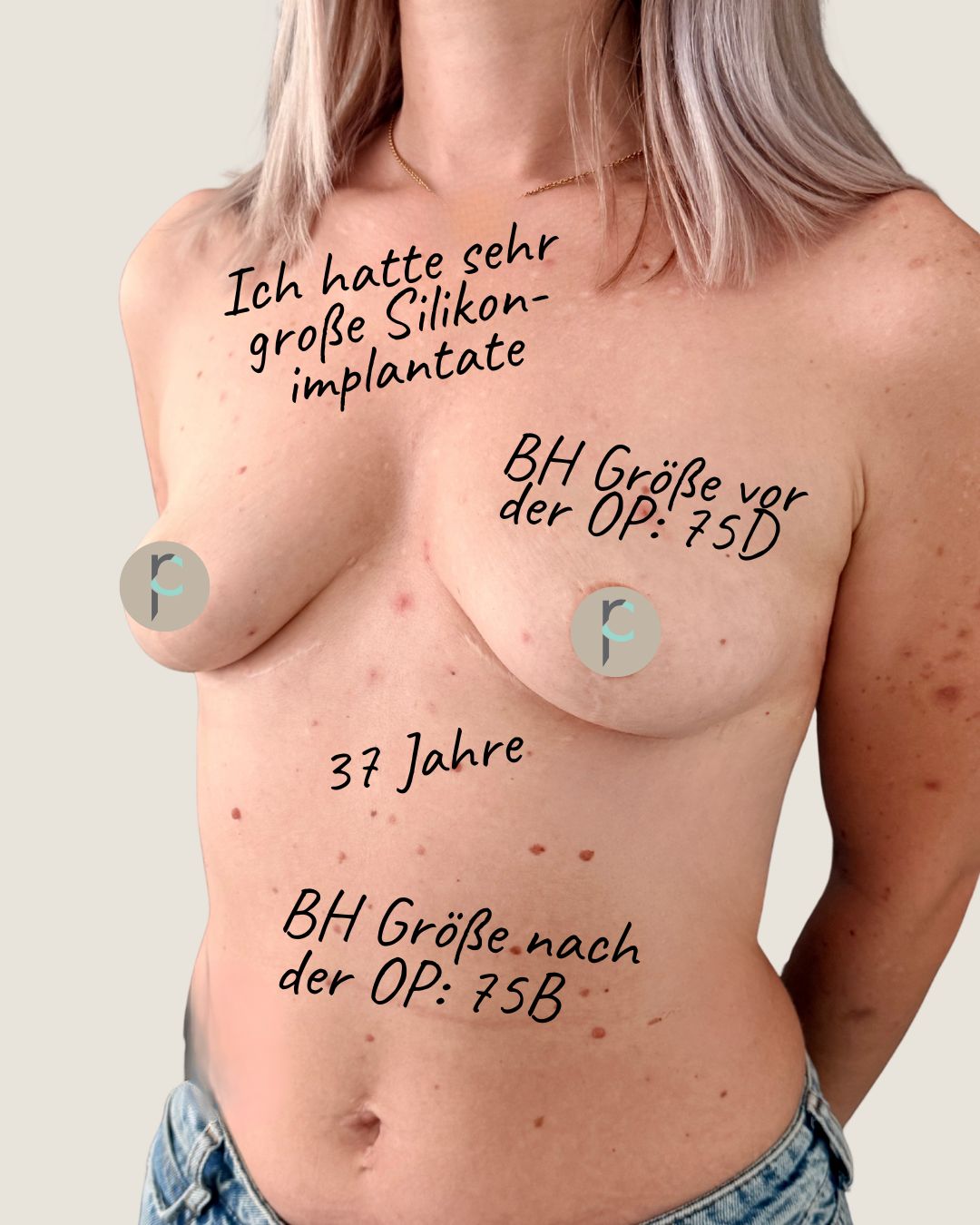
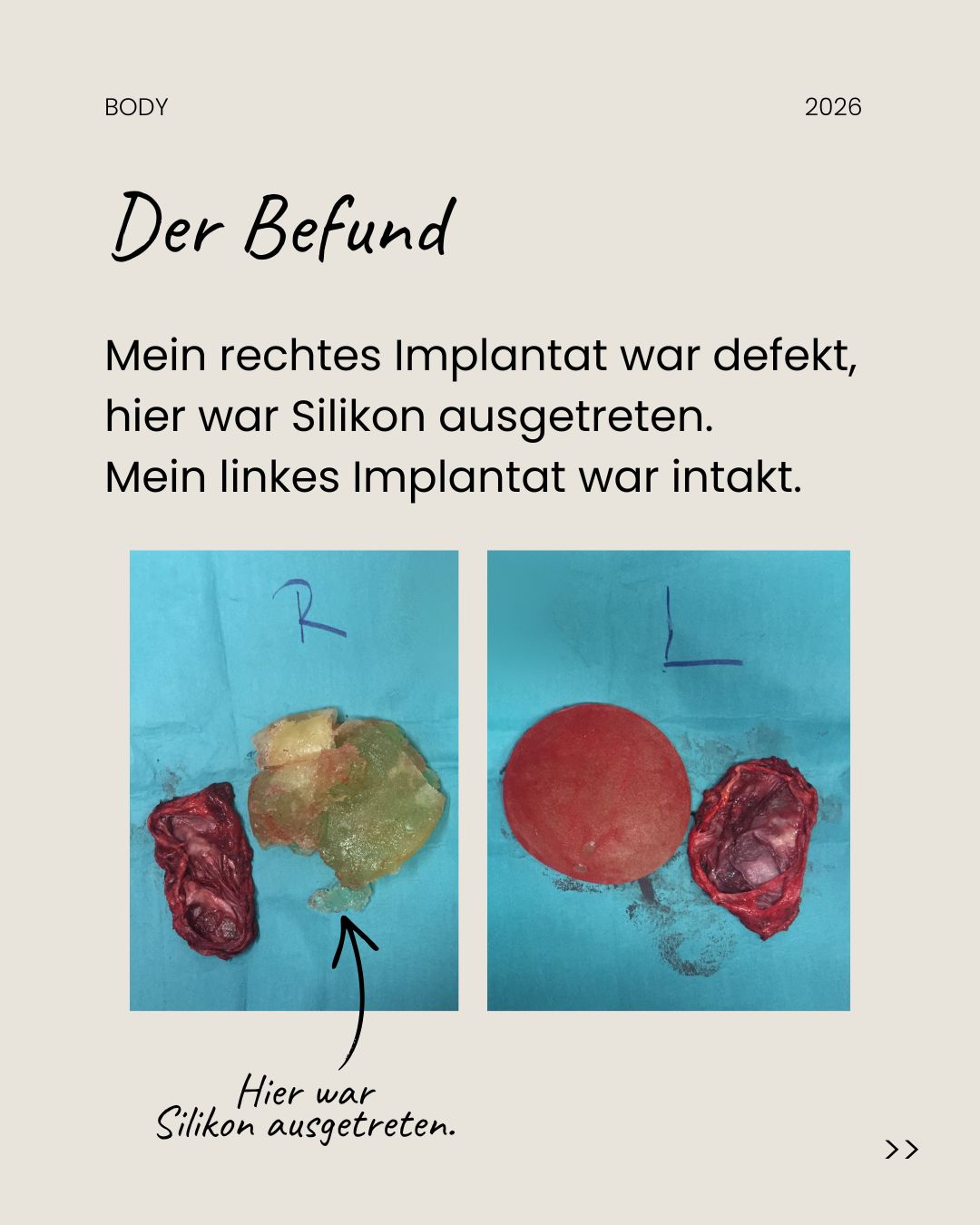
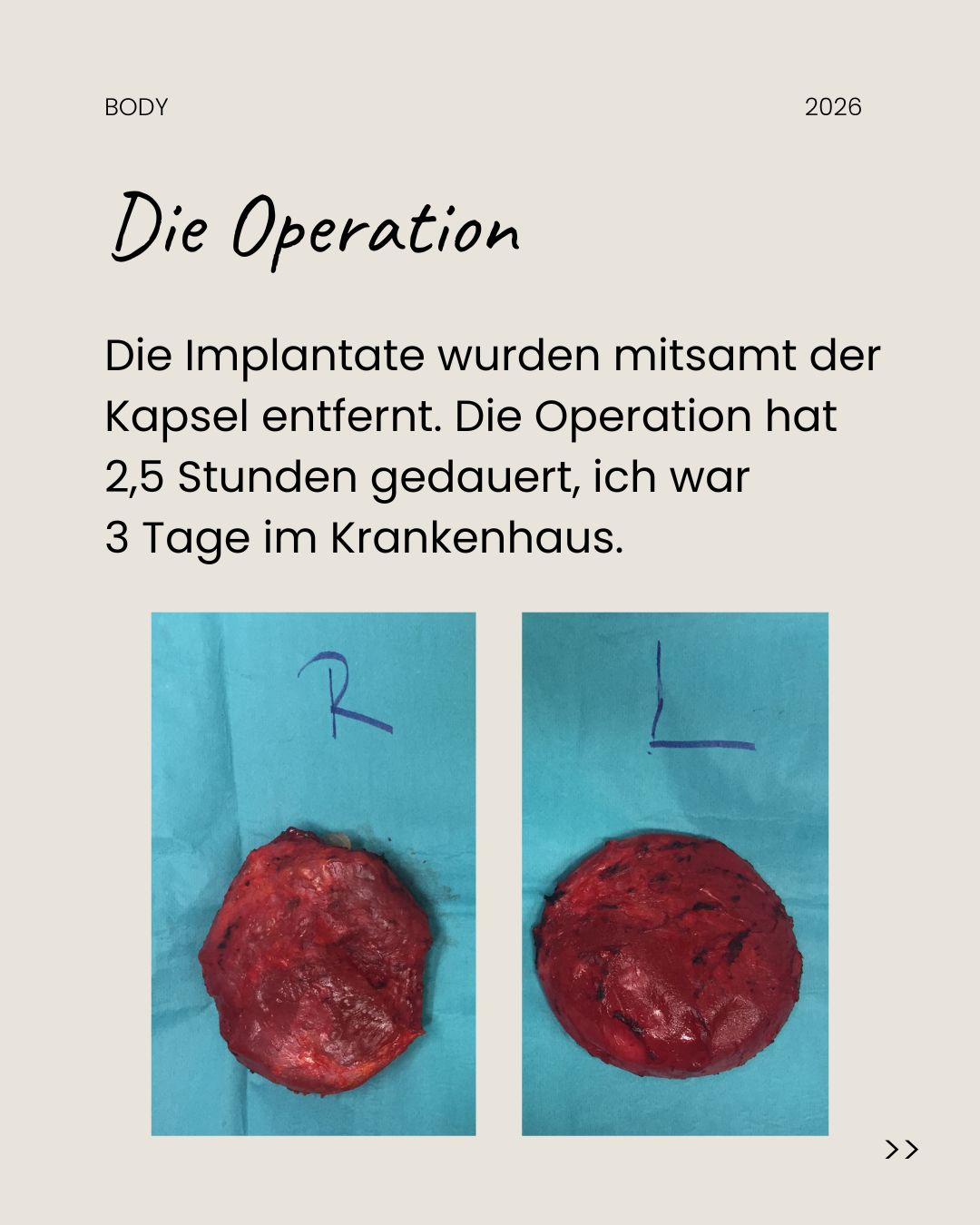
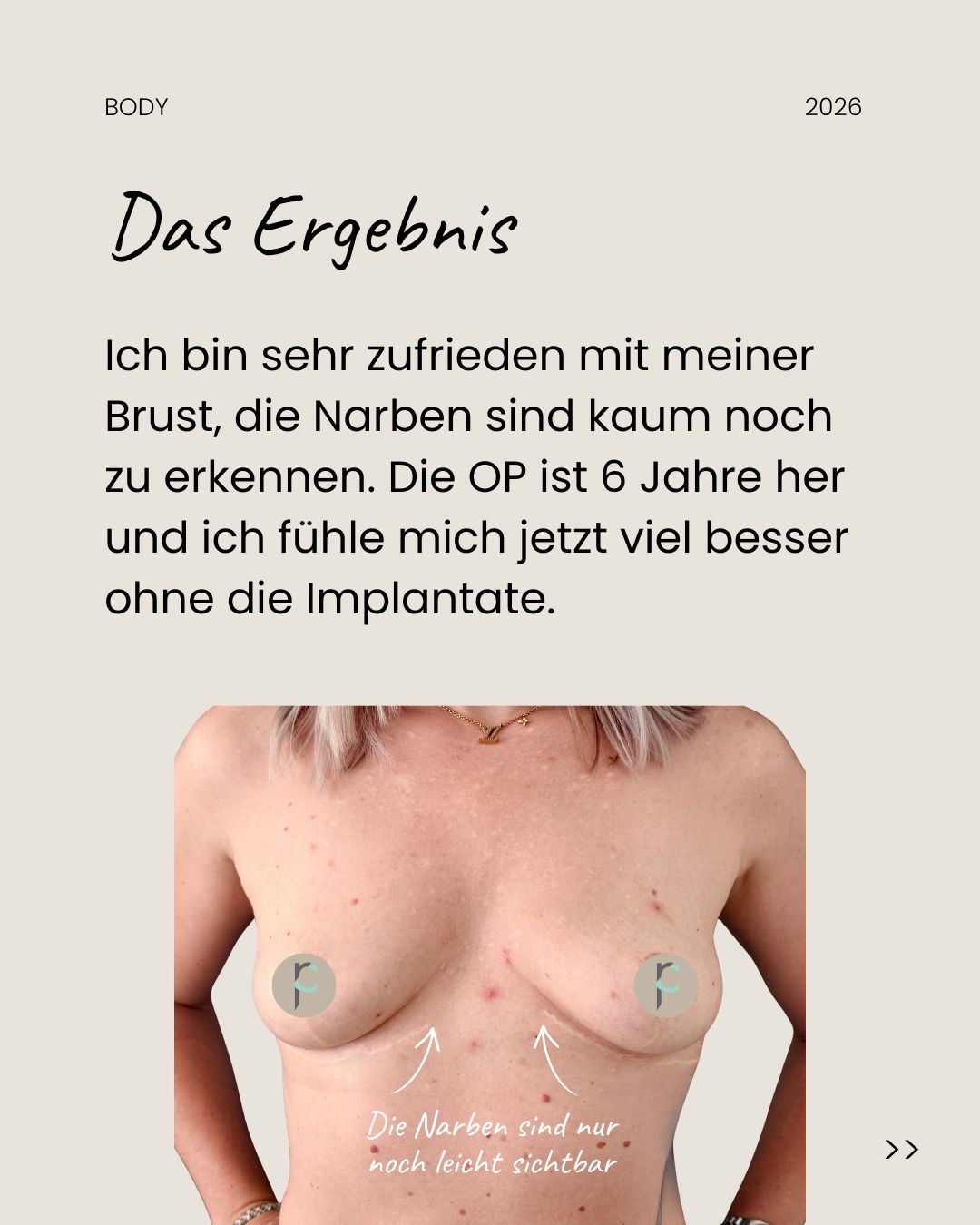

Six of the seven slides present her own words, from her symptoms to how she feels today; the last is the practice’s invitation to a consultation. Three slides show her unclothed upper body after the removal, and two show the removed implants and capsules, on which blood is also visible. These images serve to inform about the procedure and do not constitute advertising for a specific result. There is no before-and-after pair of images for comparison. View post on Instagram ↗
The patient lists her symptoms on the second slide, adding “among other things.” Brain fog refers to declining concentration and memory. For her, the cause was clear: “My silicone implants made me very sick.”
Women who attribute such symptoms to their breast implants call it Breast Implant Illness, or BII for short. BII is not a recognized diagnosis. There is no ICD code, and no test can prove a link to the implants, according to the German Society of Plastic, Reconstructive, and Aesthetic Surgeons (DGPRÄC). Fatigue or body aches can have many causes. What studies show about removal for such symptoms, and where their limits lie, is covered in our guide Breast Implant Illness.
Both implants were removed, each with the capsule surrounding it; the medical term is total implant capsulectomy. By her account, the surgery took two and a half hours, and afterward she stayed three days at our practice’s own clinic in Oberursel.
The photos of the removed implants show the findings: the right one was defective, and silicone had leaked out. The left one was intact. A defective implant can be detected; BII cannot. Leaked silicone is also one of the findings that make removing the capsule medically necessary.
Whether her symptoms were related to the defect, to both implants, or to something else cannot be determined from this case.
How the surgery works, how long healing takes, and what it costs are covered on our page about Implant Removal.
By her own account, her implants were very large, and without them her breasts are noticeably smaller: on one slide she noted a European bra size of 75D before and 75B after the surgery. Any woman who has her implants removed without replacing them should expect this. How much smaller depends on the size of the implants, the skin, and her own breast tissue.
Six years after the surgery, she writes that she now feels much better without the implants. That is her account. No one can predict whether symptoms will improve after removal, for her or for any other woman, and some women notice no change afterward.
“I’m very happy with my breasts, and the scars are barely visible now.”
— Patient, six years after the surgery
Note: This case is an individual example. How the breasts look after removal and how the scars heal depend on the implants, the patient’s own tissue, and the healing process. Her statement that she feels much better describes her experience and is not an outcome that can be generalized to other patients.
No. Breast Implant Illness is not a recognized diagnosis; there is no ICD code and no test that proves a link. What can be determined is the condition of the implants: ultrasound and, if needed, an MRI reveal problems such as a defect or a hardened capsule. The workup also includes ruling out other causes of the symptoms.
There is no way to tell beforehand. Many women report an improvement afterward, some notice no change, and there is no guarantee. We discuss this openly with you before any decision.
In our practice, we generally remove the implant and capsule together; this is called a total implant capsulectomy. It is medically necessary mainly in cases of a hardened capsule (capsular contracture), leaked silicone, or a tumor of the capsule. According to current research, no specific technique has been shown to improve symptoms described as BII.
No. It is surgery, usually under general anesthesia, and it carries risks: commonly swelling and bruising for one to three weeks, a feeling of tightness, temporary numbness of the nipples, and loose or sagging breasts, depending on the starting point; less commonly, wound-healing problems, postoperative bleeding, infections, or asymmetries. Wound-healing problems are more common in smokers. We go through every risk with you individually before any surgery.
During the consultation, we examine your implants, ask about other possible causes of your symptoms, and tell you openly what removing your implants can and cannot achieve. Consultations take place in Frankfurt and Oberursel; surgery is performed in our practice’s own operating rooms in Oberursel.
Medically reviewed by Dr. med. Zeynep Potente · Updated on October 1, 2026